 Skip to content


PCBs and Assemblies for Robot Systems
Topline Circuit supports bare PCB fabrication and PCB assembly for robot controllers, servo drives, encoder and sensor modules, and moving interconnects. Share your board revision, build quantity and operating requirements so we can review construction, assembly and testing for your quote.
Manufacturing Requirements by Board Type
| Board type | What to specify | What we review |
|---|---|---|
| Control and communication | Interface pinouts, bus settings, impedance targets and connector locations. | Stack-up, connector fit and communication test setup. |
| Servo drive and power | Continuous and peak current, peak duration, duty cycle, ambient temperature and cooling. | Finished copper thickness, high-current paths and thermal constraints. |
| Encoder and sensor | Supply range, signal levels, feedback timing and expected output. | Connector access, assembly fit and functional checks. |
| Moving joint interconnect | Bend location and radius, expected cycles and installation constraints. | Flex construction, stiffener position and strain relief requirements. |
Review Current Paths and Cooling
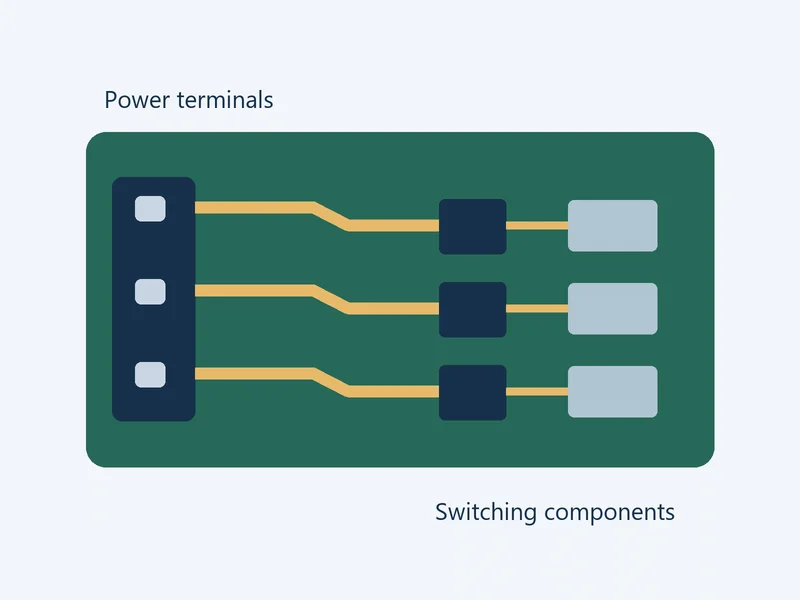
Mark the high-current paths, terminals and power components on the schematic or layout. Provide the continuous and peak current for each path, peak duration, duty cycle and allowable temperature rise. Include the proposed stack-up, finished copper thickness and cooling conditions where specified.
If the drive board requires a load test, define the supply settings, load profile, test duration and pass/fail limits.
Define Motion and Mounting Conditions

For a flex or rigid-flex assembly routed through a moving joint, send the installed flex route at both ends of the travel range. Identify the minimum bend radius, bend direction, expected cycle count, any twisting, and the locations of connectors, clamps and stiffeners.
For rigid boards, share the mounting drawing, enclosure clearances and any vibration requirements so we can review connector fit and component support.
Plan Assembly Changes and Functional Tests
Provide the released BOM, approved alternatives, placement data and assembly drawing for PCB assembly. For a revised build, mark changes to components, layout, firmware or the test procedure and identify which changes need your approval.
Specify the encoder signals, communication commands or drive outputs to test. Include supply settings, inputs, fixtures and expected responses. Specify pass/fail limits with units and timing, and whether results must be recorded by serial number.

Files for a Robotics PCB Quote
- Released Gerber or ODB++ data, drill files, stack-up and fabrication drawing
- BOM, placement data and assembly drawing for PCBA orders
- Installation drawings and applicable current, thermal or motion requirements
- Prototype and production quantities, test procedure, limits and required reports
Robotics PCB FAQs
Mark the high-current paths on the layout. Send continuous and peak currents, peak duration, duty cycle, cooling conditions and allowed temperature rise. We review finished copper thickness and stack-up against those conditions.
Send a drawing or motion sketch showing the flex route in its installed positions. Mark the bend zone, minimum bend radius, expected cycle count and fastening points. If the flex twists, show the direction and range of rotation so we can review the proposed construction.
Request per-unit testing in your quote. Send the pinout, firmware revision, input signals or commands, load, expected response and acceptance limits. State which readings, units and pass/fail results to record against each serial number. Include the response deadline for time-sensitive checks.
Provide the old and new BOM revisions, replacement datasheet and affected functions. Identify who approves the substitution and which first article checks or functional tests must be repeated before release.
Yes. Send released fabrication data for bare boards. For assembled boards, add the BOM, placement data, assembly drawing and sourcing instructions. Include programming and test requirements where applicable.
Send the current revision, intended board function, estimated quantity and the decisions still open. Mark any assumptions about current, motion or test conditions so we can identify the details needed for a firm quote.
Discuss Your Robotics PCB Requirements
Send the board revision, quantity and application. Include current, cooling or motion requirements and let us know which assembly and test records you need.