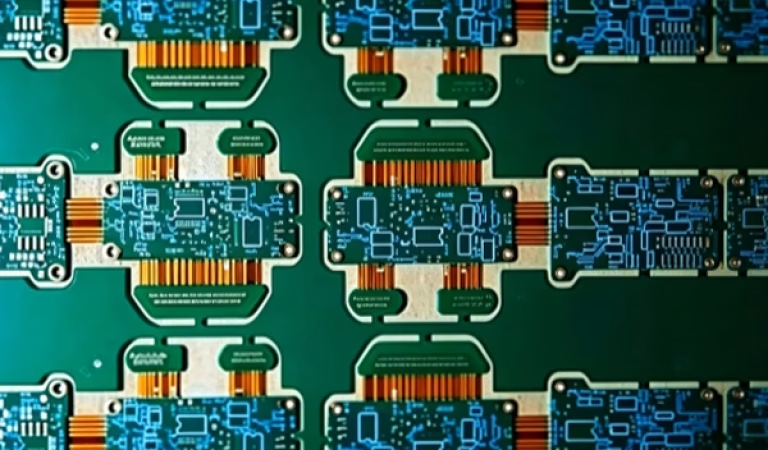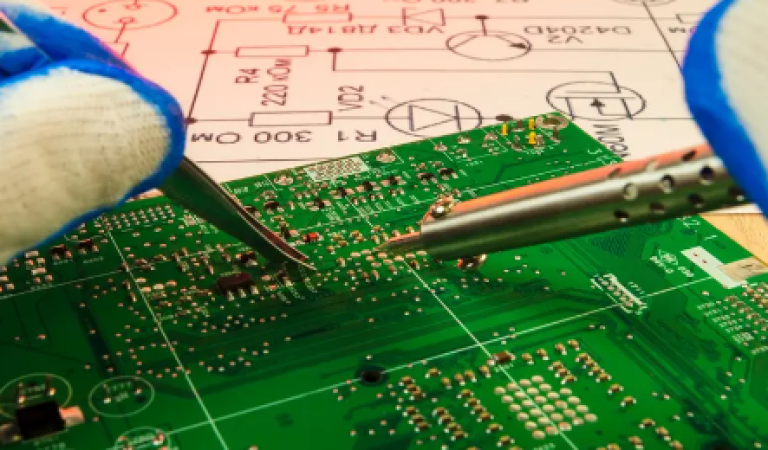

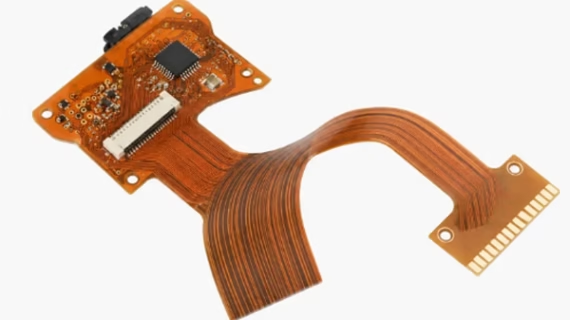
High-precision FPCs are widely used in compact electronic products, including wearables, medical devices, automotive electronics, industrial equipment, and communication products.
Compared with rigid PCBs, FPCs are thinner and more flexible. They can fit into small spaces and support stable connections in moving or bent areas.
High-precision FPCs also support fine circuits and high-density routing. This makes them suitable for products that need small size, flexible assembly, and reliable performance.
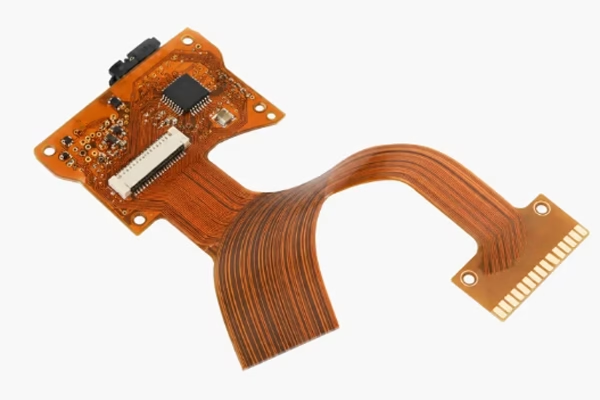
In ultra-thin devices, bending structures, and precision modules, standard FPCs may not provide enough accuracy or long-term stability.
High-precision FPCs require better control of circuit width, materials, surface finish, impedance, bending life, and assembly size.
These details help the board fit compact products and maintain stable performance during use.
What is a High-Precision Flexible Printed Circuit Board (FPC)?
A high-precision Flexible Printed Circuit Board (Flexible Printed Circuit, referred to as FPC) is an electronic circuit connection structure manufactured using flexible insulating substrate materials. It can achieve high-density routing within limited spaces while adapting to bending, folding, dynamic movement, and complex assembly structure requirements. Compared with standard FPCs, high-precision FPCs place greater emphasis on circuit precision, dimensional stability, impedance control, and long-term reliability.
High-precision FPCs usually feature finer line widths and spacing, smaller via sizes, and stricter tolerance control, making them more suitable for high-end electronic products. They can not only reduce the number of connectors and assembly space requirements, but also improve signal transmission stability and reduce the overall weight of the device.
The Difference Between High-Precision FPCs and Standard Flexible Boards
Standard flexible boards mainly solve the “connection” problem, while high-precision FPCs must not only complete the connection but also ensure high-speed signal stability, reliable dynamic bending, and long-term stability in complex structures. Therefore, during the design and manufacturing process, high-precision FPCs require stricter processing technologies and testing standards.
For example, in smart terminals and medical devices, circuit precision and stability directly affect data transmission quality. In industrial equipment and automotive electronics, flexible boards must also withstand long-term vibration and complex temperature environments. Therefore, high-precision FPCs place greater emphasis on reliability and overall performance.
Main Features of High-Precision Flexible Printed Circuit Boards
| Main Feature | Technical Performance | Core Advantage |
| Ultra-fine circuit design | Smaller line width/spacing | Improves routing density |
| High flexibility | Dynamic bending capability | Adapts to complex structures |
| Lightweight design | Ultra-thin flexible materials | Reduces product weight |
| High reliability | Long-life structure | Reduces later failure rates |
| High-precision processing | Small via size and high alignment accuracy | Meets high-end product requirements |
| Stable signal transmission | Impedance-optimized design | Reduces interference and signal loss |
Main Application Industries of High-Precision FPCs
High-precision flexible circuit boards are widely used in smartphones, laptops, medical devices, industrial control systems, automotive electronics, camera modules, display modules, drones, communication equipment, and wearable devices. Especially in electronic products with limited space and extremely high reliability requirements, high-precision FPCs have become important core components.
How Are High-Precision Flexible Printed Circuit Boards Manufactured?
Product Requirement Analysis and Structural Planning
The production of high-precision FPCs is not simply based on drawings, but requires structural planning according to the actual product application environment. Before design, it is necessary to confirm the product installation method, bending areas, dynamic movement requirements, operating temperature, and signal transmission requirements.For example, wearable devices focus more on lightweight structures and dynamic bending performance, while industrial equipment places more emphasis on durability and anti-interference capability. Therefore, performing reasonable structural analysis during the early project stage can effectively reduce later modifications and mass production risks.
High-Precision Circuit Design and Layout Optimization
High-precision FPCs usually require finer circuit designs. Therefore, during circuit layout, it is necessary to control line length consistency, reduce signal crossover, optimize grounding structures, and properly arrange via locations. For high-speed signal products, impedance control designs must also be added.At the same time, in flexible bending areas, sharp-angle routing and overly concentrated wiring should be avoided to reduce the risk of metal fatigue after long-term bending.
Precision Manufacturing Process Control
High-precision FPCs require extremely high manufacturing precision, including exposure accuracy, etching control, alignment precision, and hole processing precision. Especially for fine-line products, higher requirements are placed on circuit edge integrity and copper thickness uniformity.In addition, during lamination and coverlay processes, material shrinkage and thermal deformation must also be controlled to ensure final dimensional accuracy and circuit stability.
Surface Treatment and Reliability Testing
High-precision FPCs usually adopt ENIG immersion gold, OSP, or other highly reliable surface treatment methods according to application requirements to improve soldering stability and oxidation resistance. After manufacturing is completed, continuity testing, impedance testing, bending testing, and environmental reliability testing are also required.
| Manufacturing Step | Main Function |
| Requirement analysis | Clarifies product structure and application environment |
| Precision circuit design | Improves routing stability |
| Fine processing | Achieves high-precision circuit formation |
| Surface treatment | Improves soldering and oxidation resistance |
| Finished product testing | Verifies long-term reliability |
How to Achieve High-Quality High-Precision Flexible Printed Circuit Boards?
Production Characteristics of High-Precision FPCs
The biggest feature of high-precision FPCs is that they not only require electrical continuity, but also long-term stable operation. Because the circuits are denser, higher precision is required for exposure, etching, lamination, and hole processing during manufacturing.At the same time, high-precision flexible boards must also solve reliability issues related to dynamic bending, thermal expansion and contraction, and complex environments. Therefore, high-precision FPCs usually require stricter process control and higher-level inspection procedures.
Design Features:
· High-Density Circuit Design
High-precision FPCs usually adopt finer line widths and spacing to meet the needs of miniaturized electronic products. Through high-density design, more functional circuits can be integrated into limited spaces, improving the overall integration level of the product.
· Dynamic Bending Structure Optimization
For products requiring long-term bending, the routing direction in flexible areas is specially optimized during design to reduce stress concentration and lower the risk of cracking after long-term use.
· Impedance Control Design
In high-speed signal transmission applications, high-precision FPCs require strict impedance stability control to reduce signal reflection, crosstalk, and signal loss.
· Lightweight and Ultra-Thin Design
High-precision flexible boards usually use thinner materials and more compact structures, helping electronic products further reduce size and weight.
· High-Reliability Interface Design
In connection areas, pad stability and reinforcement structures are strengthened to improve long-term insertion, removal, and assembly reliability.
How to Improve the Reliability of High-Precision FPCs?
Improving the reliability of high-precision FPCs is not only about increasing circuit precision, but also involves material matching, bending design, copper foil structure, surface treatment, and manufacturing stability. For example, optimizing the coverlay structure can reduce the impact of external environments on circuits, while improving copper foil ductility can extend dynamic bending lifespan.In addition, reasonable reinforcement structure design can reduce mechanical stress during assembly and improve overall stability.
Technical Optimization Solutions
| Technical Direction | Optimization Solution | Target Effect |
| Fine circuitry | High-precision exposure and etching | Improves circuit consistency |
| Dynamic bending | Optimized flexible area layout | Extends bending lifespan |
| Impedance control | Precision circuit structure design | Stabilizes high-speed signals |
| Surface treatment | ENIG immersion gold / OSP | Improves soldering reliability |
| Alignment precision | Precision lamination process | Improves product stability |
| Environmental adaptability | Heat- and moisture-resistant materials | Enhances long-term reliability |
What Materials Should Be Used for High-Precision Flexible Printed Circuit Boards?
· Flexible Substrate Selection
High-precision FPCs usually use Polyimide (PI) materials. PI has excellent heat resistance, flexibility, and dimensional stability, enabling it to adapt to high-temperature soldering and long-term dynamic bending environments.For high-end products, PI materials affect not only bending lifespan, but also circuit stability and dimensional precision.
· Copper Foil Material Selection
High-precision FPCs usually use Rolled Annealed Copper (RA copper) or high-performance electrolytic copper. RA copper has better flexibility and fatigue resistance, making it more suitable for dynamically bent products.Reasonable copper thickness design can balance conductive performance and flexibility requirements, preventing reduced flexibility caused by overly thick copper layers.
· Coverlay and Reinforcement Material Selection
Coverlay films are used to protect circuits from moisture, dust, and mechanical damage. For connection areas, FR4, PI stiffeners, or steel sheet reinforcement structures are added to improve local strength and assembly stability.
· Surface Treatment Material Selection
According to different application requirements, high-precision FPCs can use ENIG immersion gold, OSP, or gold plating processes. Immersion gold processes are generally more suitable for high reliability, high-frequency contact, and long-term stable usage scenarios.
| Material Area | Common Materials | Main Function |
| Flexible substrate | PI (Polyimide) | Heat resistance and bend resistance |
| Copper foil | RA copper / electrolytic copper | Signal transmission |
| Cover layer | Coverlay film | Circuit protection |
| Reinforcement materials | FR4 / PI / steel sheet | Improves local strength |
| Surface treatment | ENIG / OSP | Improves oxidation resistance and soldering performance |
Do You Need High-Precision Flexible Printed Circuit Boards?
If your product requires ultra-thin structures, high-density routing, dynamic bending, high-speed signal transmission, or long-term stable operation, then high-precision FPCs are usually a more suitable solution. For example, medical devices require more stable data connections, industrial equipment requires greater durability, and consumer electronics focus more on lightweight design and space utilization.Compared with ordinary flexible boards, although high-precision FPCs have higher manufacturing requirements, they can effectively improve product performance, reduce later-stage failure rates, and optimize overall structural design. Therefore, for high-end electronic products, high-precision FPCs have become an important part of enhancing product competitiveness.
What Services Can We Provide for You?
Topline Circuit provides custom high-precision FPC manufacturing for consumer electronics, industrial control, medical devices, and automotive electronics.
We support material selection, circuit optimization, sample making, and mass production. Each FPC can be customized based on product size, structure, bending requirements, and application environment.
High-precision FPCs are suitable for compact products that need fine circuits, stable connections, and reliable long-term performance. They help save space, reduce weight, and support flexible assembly.
For custom high-precision FPC support, please contact us at sales@toplinecircuit.com.