


In the field of modern electronics manufacturing, products are constantly evolving towards miniaturization, high performance, and high integration. Traditional through-hole assembly methods can no longer meet the demands of high-density circuits. As a mainstream assembly method, SMT (Surface Mount Technology) achieves high-efficiency production and high-precision manufacturing by directly mounting electronic components onto the PCB surface, and has become a core process in consumer electronics, communication equipment, and industrial control systems.
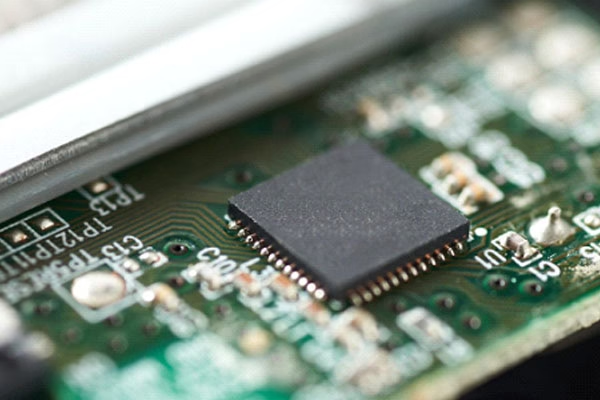
SMT Assembly Capabilities
We offer comprehensive SMT prototyping PCB assembly and small-batch production services, supporting a combination of manual placement and fully automated SMT production lines. This allows for flexible adaptation to projects with varying complexity, lead times, and cost control requirements.
Our production capabilities cover standard consumer electronics products and also support high-density, high-reliability, and industrial applications, including communication equipment, power management systems, medical electronics, and automotive electronic control boards.
SMT assembly capabilities range
| project | Ability Description |
| Production type | Prototype prototyping / Small-batch trial production / Small to medium-scale mass production |
| Mounting method | Manual SMT / Fully Automatic High-Speed Placement |
| PCB structure | Single-sided / Double-sided / Multi-layer HDI Structure |
| Component density | Delivery cycle |
| Process combination | SMT + THT hybrid assembly capability |
Through a comprehensive production scheduling and process management system, we can achieve high-efficiency delivery while ensuring consistent quality, helping customers accelerate product iteration and time-to-market.
Assembleable Component Types
Surface Mount Technology (SMT) assembly in electronics manufacturing boasts broad component compatibility, enabling the efficient mounting of various electronic components with different structures and functions. Its core feature lies in its surface mounting method, allowing various components to be directly fixed to the PCB surface without through-holes, thus accommodating more complex circuit design requirements.
- In practical applications, SMT can assemble common passive components, such as resistors, capacitors, and inductors. These components typically exist in a chip structure, are small in size, and are suitable for high-density layouts.
- It also supports the mounting of various active components, including diodes, transistors, and various integrated circuit chips, which play a core role in functional implementation.
This compatibility with multiple component types allows SMT assembly to cover manufacturing needs from basic electronic modules to high-performance system-level products, ensuring assembly efficiency while providing ample implementation space for high-density, highly integrated circuit designs.
Design-Driven Manufacturing Philosophy
We consistently adhere to the “design-driven manufacturing” philosophy, ensuring that the SMT assembly process is highly aligned with the customer’s circuit design goals, thereby ensuring the optimal balance between functionality, reliability, and manufacturability. During the project initiation phase, we offer free DFM (Design for Manufacturability) analysis services, comprehensively evaluating PCB layout, pad design, spacing rules, and component selection, and providing optimization suggestions to reduce production risks and improve overall yield. During manufacturing, we strictly control reflow soldering profile parameters and develop differentiated temperature strategies for different package types (such as BGA, QFN, and Fine Pitch devices) to ensure adequate solder joint wetting and minimize stress, thereby improving long-term reliability.
SMT Quality Control and Inspection System
To ensure the stability and consistency of SMT assembly, we have established a multi-level quality inspection system to rigorously monitor and verify the entire production process.
Comparison of SMT inspection methods
| Detection method | Detection capabilities | Scope of application |
| Manual visual inspection | Appearance defects, component misalignment | Conventional surface elements |
| AOI (Automated Optical Inspection) | Solder joint quality and mounting accuracy | Visible solder joint components |
| X-ray inspection | Internal solder joint structure analysis | Hidden solder joints such as BGA / QFN / DFN |
In BGA, QFN, and DFN packages with non-visible solder joints, we utilize high-resolution X-ray inspection technology for structural analysis of solder joints. This identifies critical defects such as void ratios, cold solder joints, bridging, and solder ball misalignment, ensuring stable performance of key components in high-reliability applications.
We combine a reflow soldering real-time monitoring system with process data logging to achieve end-to-end traceable quality management.
Future Trends in SMT Assembly
As electronic products continue to evolve towards higher performance and miniaturization, the types of components that SMT assembly can support are also constantly evolving, expanding from traditional basic components to more complex and integrated ones. Future changes will not only be reflected in the increase in component types but also in the upgrade of structural forms and functional integration capabilities.
- In terms of component form: Components will continue to develop towards miniaturization, with more and more ultra-small devices being applied to actual production, enabling SMT to complete more functional integration within a more limited space. This trend drives continuous improvement in mounting accuracy and equipment capabilities, while also making high-density assembly the norm.
- In terms of functional structure: Components will shift from single-function to highly integrated, for example, multi-functional packaging and system-in-package (SoC) are becoming increasingly common, allowing multiple chips or modules to be integrated into the same package to complete complex tasks. This change means that SMT is no longer just about “placing components” but is directly involved in realizing system-level integration capabilities.
- In terms of application types: Component types will become more diverse, expanding from traditional passive devices and basic ICs to high-frequency communication devices, power devices, and various smart sensors to meet the needs of emerging fields such as 5G, the Internet of Things, and new energy vehicles. These new components place higher demands on performance, reliability, and environmental adaptability, driving the continuous upgrading of SMT technology.
Meanwhile, with the development of intelligent manufacturing, SMT assembly will better adapt to the diverse component needs, achieving flexible switching and efficient production of different types of components through automation and data-driven methods, giving production lines greater compatibility and adaptability.