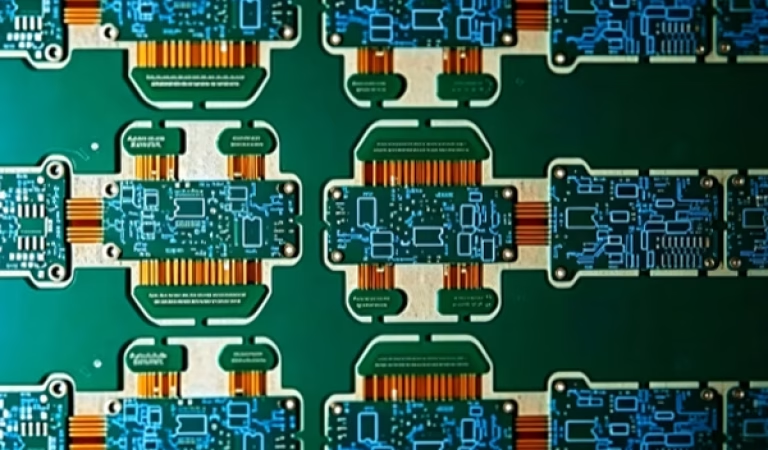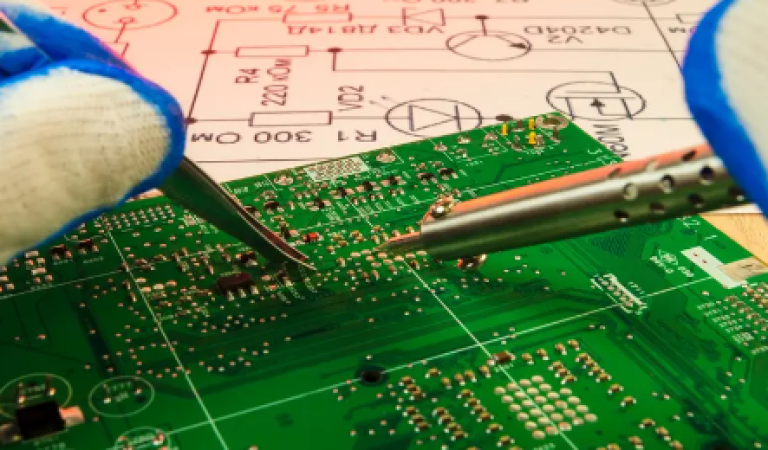

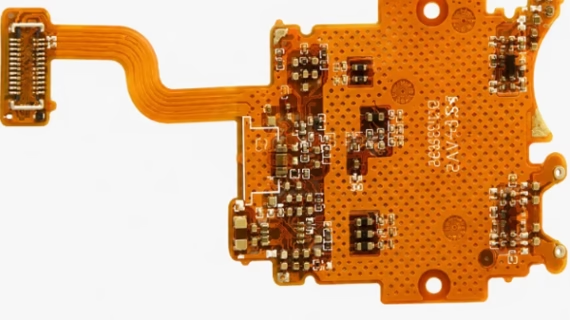
FPC mobile phone keypad boards are used for side buttons, volume buttons, power buttons, and function keys. They provide stable circuit connection and smooth button response.
FPC boards are thin and flexible. They fit well in compact phone structures and can handle repeated bending during use.
Custom FPC keypad boards can be made to match different phone sizes, button layouts, and assembly needs. This helps improve reliability and makes production easier.
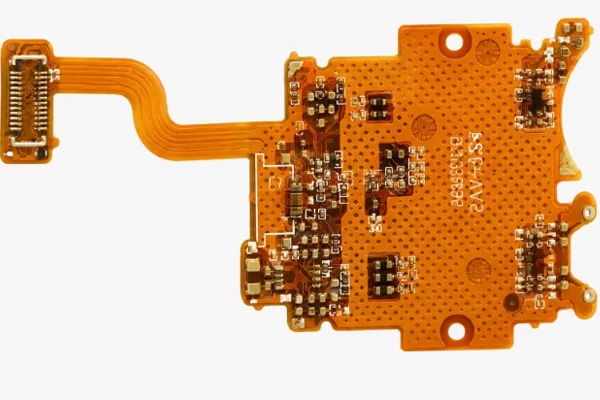
What Is a Custom High-Performance FPC Mobile Phone Keypad Board
A custom high-performance FPC mobile phone keypad board refers to a flexible printed circuit board specially designed and manufactured according to the structural space, key layout, electrical requirements, and assembly method of a mobile phone product. It is commonly applied in keypad areas to connect button switches, control signal circuits, indicator lights, or other functional modules. Unlike standardized universal boards, custom FPCs emphasize “design on demand,” allowing optimization of line width, layer count, reinforcement methods, bending areas, surface treatment, and material combinations based on customer requirements.
Overview of Custom FPC Mobile Phone Keypad Board Information
| Item | Description |
| Product Name | Custom High-Performance FPC Mobile Phone Keypad Board |
| Main Function | Signal connection and stable control for mobile phone keypad areas |
| Applicable Structures | Side buttons, volume buttons, power buttons, function buttons, test buttons, etc. |
| Core Requirements | High precision, bending resistance, heat resistance, stable conductivity |
| Customization Focus | Dimensions, layer count, openings, reinforcement, solder mask, surface treatment |
| Usage Features | Thin, lightweight, bendable, suitable for complex phone structures |
From a professional perspective, FPC mobile phone keypad boards are not simply designed to “work.” They must maintain low failure rates and stable tactile performance during long-term use. Especially in mobile phone products with high-frequency button operation, limited assembly space, and complex internal structures, the rationality of the FPC design directly affects the overall user experience. Therefore, custom high-performance FPC mobile phone keypad boards are essentially laying the foundation for product reliability and market competitiveness.
Application Areas of High-Performance FPC Mobile Phone Keypad Boards
The application range of high-performance FPC mobile phone keypad boards is not limited to standard smartphones. They are also widely used in electronic products requiring compact structures, precise key feedback, and high stability. As consumer electronics continue to evolve rapidly, the application scenarios of FPC keypad boards are becoming increasingly diverse.
· Smartphone Keypad Areas
This is the most common application area, including power buttons, volume buttons, mute switches, camera buttons, and more. Since internal phone space is extremely limited, traditional rigid boards often struggle with flexible routing, while FPCs allow freer circuit routing and thinner structural designs.
· Foldable Screens and Ultra-Thin Terminal Devices
These products place higher demands on bending lifespan, circuit stability, and structural compatibility. FPC keypad boards can maintain reliable connections within limited spaces and are suitable for complex dynamic structures.
· High-End Communication Terminals and Industrial Handheld Devices
In some industrial-grade devices, buttons are used frequently, while environmental temperature differences and vibration are more significant. Therefore, FPC keypad boards must provide stronger anti-interference capability and durability.
· Wearable and Compact Smart Devices
As devices become smaller, every millimeter of internal space becomes valuable. FPC keypad boards have become an important solution for achieving miniaturized designs.
Application Scenario Comparison Table
| Application Scenario | Design Focus | Common Challenges |
| Smartphones | Thin profile, consistent tactile feel | Compact space, high assembly precision |
| Foldable Devices | Bending lifespan, dynamic reliability | Repeated bending, material fatigue |
| Industrial Handheld Devices | Stability, environmental resistance | Vibration, temperature variation, long-term use |
| Wearable Devices | Miniaturization, lightweight design | Limited structural space, difficult routing |
Different application scenarios require different FPC keypad board specifications, making customized design extremely important. Only by planning materials, structures, and manufacturing processes according to the product application can the advantages of FPC technology be fully realized.
Advantages of High-Performance FPC Mobile Phone Keypad Boards
The main reason why high-performance FPC mobile phone keypad boards are attracting increasing customer attention is their ability to simultaneously satisfy the requirements of being “lightweight, thin, stable, and flexible.” In modern smartphones, no component can be evaluated based on a single performance factor alone; it must also support overall structural design and long-term usability.
· Saving Internal Space and Improving Design Flexibility
FPCs are soft and bendable, allowing routing around other components within complex structures. This helps engineers optimize internal layouts more effectively, which is especially important for highly integrated smartphone products.
· Lighter Weight for Slimmer Products
Compared with traditional connection solutions, FPCs provide superior lightweight advantages, making them ideal for ultra-thin terminal devices.
· Stable Electrical Performance and Reliable Signal Transmission
With proper circuit design and material selection, high-performance FPCs can maintain excellent conductivity stability and reduce issues such as poor contact and signal fluctuation.
· Adaptability to Complex Assembly Structures
Mobile phones contain densely packed components and limited installation space. FPCs can bend, fold, and position according to structural requirements, providing stronger assembly adaptability.
Support for Personalized Customization and Product Differentiation
Different smartphone brands have varying button positions, thicknesses, structures, and functions. Customized FPCs help products better fit complete device solutions and enhance market competitiveness.High-performance FPC mobile phone keypad boards are not only functional components but also an important foundation for improving overall device quality. For high-end smartphone brands, the quality of the FPC often affects button feedback, assembly consistency, and after-sales repair rates. Therefore, its value extends far beyond simple “connection.”
Why Custom High-Performance FPC Mobile Phone Keypad Boards Are Necessary
Many people believe that a keypad board only needs to conduct electricity properly. In reality, mobile phone keypad boards must withstand high-frequency pressing, compact structures, complex assembly processes, and long-term use. Although standardized products are convenient, they are difficult to fully adapt to the structural requirements of every smartphone model, making customization a more practical solution.
· Different Mobile Phone Structures
Different phone models have different motherboard positions, key locations, routing paths, and housing spaces. Standard FPCs are often unable to match perfectly, leading to assembly difficulties or structural interference.
· More Specialized Functional Requirements
Some smartphones require independent button control, while others integrate multiple functional signals or cooperate with indicator lights and sensor modules. These requirements can only be achieved through customization.
· Higher Reliability Requirements
Smartphones are high-frequency-use products, and keypad area failures directly affect user experience. Custom high-performance FPCs improve reliability through more suitable materials and manufacturing processes.
· Consistency in Mass Production
Customized design is not only for adapting to individual prototypes, but also for maintaining stable consistency during mass production, reducing repair rates and production fluctuations.
Why Choose Customization Instead of Standard Parts
| Item | Standard FPC | Custom High-Performance FPC |
| Structural Compatibility | General | More precise |
| Circuit Design | Fixed | Optimized according to requirements |
| Space Utilization | Limited | More efficient |
| Assembly Efficiency | May be affected | Smoother |
| Usage Reliability | Medium | Higher |
| Product Differentiation | Weak | Strong |
Therefore, custom high-performance FPC mobile phone keypad boards are not simply an “additional cost.” Instead, they optimize design in the early stage, reduce later assembly issues and after-sales risks, and improve overall product value.
Technical Challenges of Custom High-Performance FPC Mobile Phone Keypad Boards
Although custom high-performance FPC mobile phone keypad boards may appear to be small components, they require high standards in design, materials, manufacturing, and quality control. Smartphone keypad boards are especially sensitive to dimensional tolerances, circuit precision, bending stability, and long-term conductivity performance.
· High Dimensional Accuracy Requirements
The internal space of mobile phones is extremely compact. If the FPC dimensions deviate too much, alignment issues, assembly interference, or installation difficulties may occur. In keypad areas especially, dimensional errors directly affect overall assembly quality.
· Fatigue in Bending Areas
Although FPCs are flexible, repeated bending can still cause fatigue damage. Therefore, the line width, reinforcement structure, and material thickness in bending areas must be properly designed to prevent broken traces, cracking, or performance degradation.
· Fine Circuits and Small Spacing Increase Processing Difficulty
To adapt to thinner smartphone designs, circuits are becoming increasingly fine. This creates higher requirements for etching precision, solder mask control, and layer alignment.
· Strict Requirements for High Temperature and Soldering Processes
During SMT and soldering processes, insufficient heat resistance may cause substrate deformation, adhesive failure, or abnormal solder pads, affecting the overall keypad board quality.
· Difficulty in Maintaining Batch Consistency
Producing excellent samples does not guarantee stable mass production. The true challenge lies in ensuring that every production batch maintains consistent dimensions, performance, and appearance.
How Our Company Solves These Technical Challenges?
When customizing high-performance FPC mobile phone keypad boards, our company controls risks starting from the design stage. First, through structural evaluation and circuit optimization, we minimize unnecessary bending and stress concentration. Second, we select appropriate substrates, copper thicknesses, and reinforcement solutions according to the product application environment to improve board durability. Third, during production, we strengthen control over exposure, etching, lamination, forming, and inspection processes to reduce fine-line processing errors. Finally, before mass production, we conduct sample verification and process confirmation to ensure stable product performance during volume delivery. This approach not only solves common issues such as dimensional deviation, circuit breakage, and poor assembly, but also provides customers with greater confidence during mass production.
Materials That Determine the Quality of High-Performance FPC Mobile Phone Keypad Boards
The performance of FPC mobile phone keypad boards largely depends on material selection. When suitable materials are chosen, the board performs better in flexibility, heat resistance, durability, and manufacturing stability. If unsuitable materials are selected, even refined processing techniques cannot fully compensate afterward.
Common Materials and Their Features
| Material Type | Features | Application Description |
| PI Substrate | High heat resistance and flexibility | Common core substrate for FPC |
| Copper Foil | Excellent conductivity and machinability | Key material for circuit conduction |
| Adhesive Layer | Connects substrate and copper layer | Affects heat resistance and stability |
| Coverlay Film | Protects circuits and prevents oxidation | Improves insulation and reliability |
| Reinforcement Board | Enhances local mechanical strength | Commonly used in connectors and soldering areas |
| Surface Treatment Layer | Improves solderability and oxidation resistance | Affects subsequent assembly quality |
Material Selection Principles
· Prioritize Heat Resistance
Mobile phone keypad boards may experience heat during soldering and long-term operation, so substrates must provide sufficient heat resistance to avoid deformation and failure.
· Balance Flexibility and Strength
The most important characteristic of FPC is flexibility, but flexibility does not mean fragility. Proper material combinations should allow bending while maintaining stable circuits.
· Choose Reinforcement According to Structure
Adding reinforcement materials in connector areas, soldering zones, or high-stress positions can effectively improve mechanical strength and assembly reliability.
Select Surface Treatment Based on Application
Different smartphone products require varying levels of solderability, corrosion resistance, and contact stability, so surface treatment methods should be selected accordingly.Material selection is not about choosing the most expensive option, but the most suitable one. Truly high-performance FPC mobile phone keypad boards achieve the best balance among material combinations, structural design, and manufacturing processes.
Frequently Asked Questions
When choosing custom FPC mobile phone keypad boards, customers usually care about practical details. These include size accuracy, bending durability, drawing-based customization, sample lead time, and mass production stability.
Clear requirements can help reduce rework and delays. Before production, customers can provide drawings, material requirements, structure details, and testing standards.
This helps confirm the solution faster and makes sample verification smoother.
Why Choosing the Right Custom Solution Is Important
FPC mobile phone keypad boards are used in side buttons, power buttons, and volume buttons. They provide stable electrical connections and reliable button response.
Topline Circuit can customize FPC keypad boards based on your product requirements. We support prototype and volume production.
For more information, please contact us at sales@toplinecircuit.com.