


As medical devices continue to evolve towards digitalization and intelligence, the electronic systems within these devices are becoming increasingly complex, and PCBs (Printed Circuit Boards) are the core foundation of these systems. A “smart medical PCB” is not simply an application of ordinary circuit boards; it is a critical carrier specifically designed for medical devices, meeting high reliability and safety requirements. From monitoring equipment and wearable health devices to imaging systems and diagnostic instruments, almost all rely on high-standard PCB support.
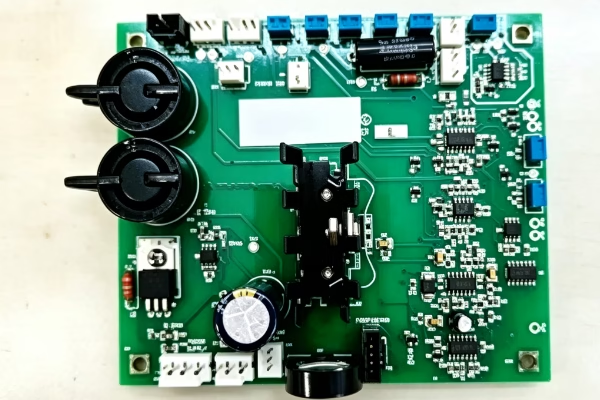
What is a Smart Medical PCB?
· The “Core Skeleton” of Medical Devices
A smart medical PCB can be understood as the “neural network carrier” in medical electronic devices. It connects key components such as chips, sensors, and power modules through conductive lines, enabling signal transmission, power distribution, and functional control. Unlike ordinary consumer PCBs, medical PCBs must not only be “usable” but also “stable, safe, and reliable over the long term.” Especially in life support devices, the reliability of the PCB directly affects the safety of device operation.
· Why do “smart healthcare” place higher demands on PCBs?
Medical devices typically require continuous operation for extended periods and involve precise signal acquisition (such as ECG, blood oxygen, and imaging data). Therefore, PCBs not only need high-density routing capabilities, but also anti-interference capabilities, low noise performance, and good thermal management. Furthermore, the medical industry involves stringent regulations and standards, placing higher demands on materials, manufacturing processes, and quality traceability, making medical PCBs one of the most technically demanding products in the PCB field.
How are intelligent medical PCBs made?
· Design and Engineering Review Stage
Before formal production, PCB design and engineering evaluation are required. This stage mainly includes schematic design, layout and routing, and design rule checks. For medical PCBs, the design must not only meet electrical performance requirements but also consider safety isolation, signal integrity, and post-production testability. The role of engineering review is to identify potential problems in advance and avoid cost waste after production begins.
· Manufacturing and Processing Stage
After design confirmation, the PCB manufacturing stage begins, including substrate treatment, circuit forming, drilling, electroplating, etching, and surface treatment. Medical PCBs typically involve multilayer boards, HDI structures, or flexible circuits, resulting in high process complexity. Each step requires strict precision control to ensure circuit integrity and hole accuracy.
· Assembly and Testing Phase
After manufacturing, SMT (Surface Mount Technology) or DIP (Device In-line Package) assembly is required to mount electronic components onto the PCB. Functional testing, electrical testing, and reliability verification are then performed. Medical devices have more stringent testing requirements, often necessitating aging tests or environmental simulation tests to ensure stable operation in real-world environments.
How to Build a High-Quality Smart Medical PCB?
· Signal Integrity and Interference Suppression Design
Many signals in medical devices are weak, such as ECG signals. If the PCB design is inadequate, they are easily susceptible to external electromagnetic interference. Therefore, the design needs to optimize trace routing, control impedance, and rationally arrange power and ground planes to reduce noise interference. This not only affects the accuracy of the device but also the reliability of diagnostic results.
· Thermal Management and Stability Control
Some medical devices generate continuous heat during operation. Insufficient PCB heat dissipation design can lead to performance degradation or even device damage. Therefore, heat dissipation paths need to be considered in the design, such as increasing copper layer thickness, optimizing layout, or using thermally conductive materials. Good thermal management can extend the device’s lifespan and improve stability.
• High-Reliability Manufacturing Standards
Medical PCBs typically require adherence to stricter quality standards, such as higher soldering reliability, lower defect rates, and more comprehensive testing processes. Every step, from material intake to finished product shipment, needs to be recorded and traceable. This “end-to-end control” is one of the key characteristics that distinguishes medical PCBs from ordinary PCBs.
What Materials are Most Suitable for Smart Medical PCBs?
• Substrate Selection Determines Performance Foundation
Medical PCBs commonly use high-performance substrates, such as high-TG (glass transition temperature) materials, to ensure stable operation in high-temperature environments. For high-frequency applications, low-loss materials are also necessary to ensure signal transmission quality. Different devices have different material requirements, necessitating matching based on the application scenario.
• Application of Special Structural Materials
Flexible PCBs (FPCs) or rigid-flex boards are widely used in wearable medical devices. These materials enable lightweight and bendable designs, improving device comfort. In high-precision devices, high-density interconnect (HDI) boards are preferred for high-density wiring and smaller size designs.
• Surface Treatment and Reliability Materials
Medical PCBs typically employ more stable surface treatments to improve soldering quality and oxidation resistance. Simultaneously, auxiliary materials such as solder and flux used in the assembly process must meet environmental and reliability requirements to avoid impacting the long-term performance of the equipment.
What are the fundamental differences between medical PCBs and ordinary PCBs?
Medical PCBs not only require greater performance stability but must also meet stringent industry standards, including material safety, production traceability, and long-term reliability verification. Ordinary PCBs focus on “functional implementation,” while medical PCBs emphasize “long-term safe operation.” Therefore, when selecting a supplier, price should not be the sole consideration; their quality system and industry experience are also crucial.Intelligent medical PCBs are the “core circuit platform” in medical equipment, responsible for connecting various electronic components to ensure proper device operation. Although it may appear as just a board, it plays a vital role, especially in the medical field where stability and safety requirements are extremely high. From design to manufacturing, assembly, and testing, every step requires strict control to prevent significant errors. Particularly in critical equipment, the quality of the PCB directly affects the reliable operation of the device. Therefore, medical PCB design is not only a technical issue but also a quality management issue. If we compare medical equipment to a system, then the PCB is the foundational platform of that system. Only when this foundation is stable can the functions above it be fully realized. For enterprises, choosing a reliable PCB partner can not only improve product quality but also shorten development cycles, allowing products to enter the market faster.
Your Trusted One-Stop PCB Manufacturing and Assembly Partner
Founded in 2000 and headquartered in Shenzhen, China, Topray Circuits is an electronic solutions provider offering PCB layout, manufacturing, assembly, testing, and verification services. Our products cover high-reliability flexible circuit boards, rigid-flex boards, RF/microwave circuit boards, HDI circuit boards, and rigid circuit boards. As a recognized technology leader, we offer rapid delivery cycles, with all processes completed internally, creating an efficient one-stop service experience. We provide end-to-end support from prototyping to mass production, including SMT/DIP assembly, functional testing, and final delivery. From engineering review to shipment, we focus on quality control and delivery stability throughout, while helping customers transition from design to mass production more quickly through clear and efficient communication.