


With the deepening integration of cloud computing and enterprise digitalization, the importance of PCB design for general-purpose servers, as the fundamental computing power carrier, is constantly increasing. Whether it’s the data processing nodes of cloud platforms or enterprise-level databases and virtualization servers, all rely on highly stable and scalable hardware architectures to support long-term operation. As the core interconnect platform for servers, the PCB needs to support complex connections between the CPU, memory, and high-speed interfaces, while also achieving high-density wiring and power integrity control within a limited space. With the continuous growth of data traffic and concurrent requests, general-purpose server PCBs are evolving from traditional multi-layer board structures towards higher integration and higher signal quality. Breaking down the PCB design around industry applications, layer count and HDI structure, and core design challenges helps to more clearly understand the key role and design logic of this type of PCB in the server system.
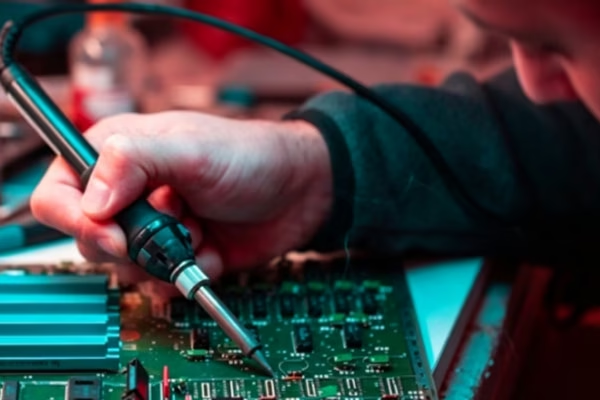
Industry applications are mainly concentrated in cloud computing and enterprise-level IT infrastructure
As digital infrastructure continues to expand, general-purpose servers have become the core carrier unit.
- Cloud computing platforms rely on a large number of general-purpose servers for virtualization resource allocation and elastic scaling; the PCB must ensure long-term stable operation.
- Enterprise IT and database systems emphasize data reliability and processing efficiency, requiring PCB designs to support continuous high-load computing and storage access.
The stability requirements of application scenarios lead general-purpose server PCBs to favor mature architectures and high-reliability designs.
Layer count and HDI structure are primarily medium-to-high density designs
At the structural design level, general-purpose server PCBs emphasize balancing performance and cost.
- Common layer counts range from 12 to 20 layers to meet the basic routing requirements between the CPU, memory, and high-speed interfaces.
- HDI structures are widely adopted, using micro-blind vias and fine lines to achieve a more compact signal layout and higher routing efficiency.
This structural design allows the PCB to maintain good scalability while controlling costs.
Multi-CPU interconnects present complex system-level design challenges
In multi-processor architectures, the interconnect structure directly impacts system performance.
- Multi-CPU interconnects require high-bandwidth, low-latency bus designs, placing high demands on PCB layer routing and synchronization control.
- The complex data exchange paths between different CPUs necessitate topology optimization to reduce signal loss.
Multi-processor collaborative computing scenarios make PCB design more focused on system-level architecture planning.
DDR5 and PCIe Expansion Place Higher Demands on High-Speed Signal Design
In high-speed data transmission environments, memory and expansion channels become critical constraints.
- DDR5 memory routing requires strict control over length equality and impedance consistency to ensure stable data read and write performance.
- PCIe channel expansion demands high-frequency signal integrity control and rational planning of multi-channel routing space.
The increase in high-speed interfaces presents greater challenges to PCB design in terms of routing density and signal control.
General Server PCB Key Design Comparison Table
| Dimension | General server PCB solutions | Main design features | Technical Focus |
| Application Scenarios | Cloud computing / Enterprise IT / Database | High stability and long-term operation | Reliability and scalability |
| Layer Structure | Layer 12–20 | Balanced design for mid-to-high layer counts | Cost and performance balance |
| HDI Structure | Widely uses HDI | High-density cabling | Signal path optimization |
| CPU Interconnect | Multi-CPU collaboration | High bandwidth and low latency | Bus design and topology optimization |
| Memory Interface | DDR5 | High-frequency, high-speed transmission | Length matching and impedance matching |
| Extension Interface | PCIe multi-channel expansion | High-speed data channel | Signal integrity |
General-purpose server PCBs play a fundamental yet crucial role in the overall server architecture, providing connectivity and load-bearing capacity. Their design focuses on achieving a reasonable balance between stability, cost, and performance. As cloud computing and enterprise applications continue to expand, the demands on server processing and scalability are constantly increasing, leading to a shift in PCB structures towards higher density and signal integrity. A systematic analysis of industry applications, structural layers, and core design challenges provides a clearer understanding of the core value of general-purpose server PCBs in data center architecture and offers a clear reference direction for subsequent hardware design optimization.