


Modern radar systems and Electronic Warfare (EW) equipment are continuously evolving toward higher frequencies, more complex signal processing, and higher levels of integration. In applications such as phased array radar, electronic reconnaissance, and electronic jamming, the PCB has transcended its role as a mere basic interconnect medium; it has become a critical platform that directly impacts RF performance and system stability. Particularly in microwave signal environments exceeding 40 GHz, PCBs must simultaneously satisfy a multitude of requirements, including low loss, high shielding effectiveness, high-precision fabrication, and high-speed digital transmission capabilities. Material selection, stack-up structure, impedance control, and manufacturing precision have all emerged as pivotal factors determining overall system performance. An analysis centered on the specific characteristics of high-frequency board applications, key technical challenges, and manufacturing requirements provides a more comprehensive understanding of the developmental trajectory for PCB solutions in radar systems.
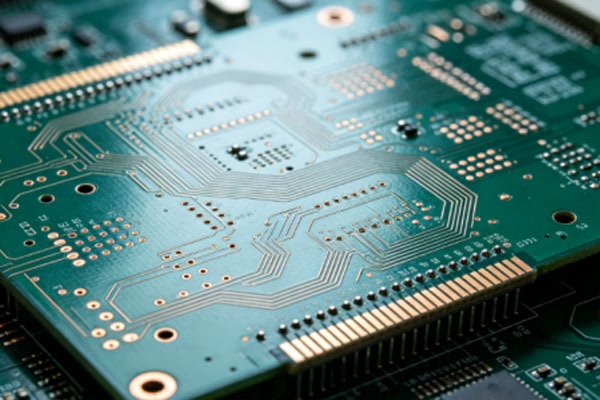
Radar and EW Systems Show Increasing Reliance on High-Frequency PCBs
In modern military electronic systems, high-frequency PCBs have become an indispensable core component.
- Beamforming networks within phased array radar systems require PCBs capable of supporting the transmission of high-frequency RF signals exceeding 40 GHz.
- Jamming and reconnaissance modules within EW systems impose extremely stringent requirements on high-speed and highly stable microwave signal processing capabilities.
The performance of high-frequency PCBs directly dictates the overall operational capabilities of radar detection and electronic countermeasures systems.
Mixed RF and High-Speed Digital Designs Present Complex Structural Challenges
In highly integrated systems, disparate types of signals must coexist on a single circuit board.
- RF, analog, and high-speed digital circuits are typically co-located on the same board, necessitating rigorous requirements for stack-up design and signal isolation.
- High-frequency analog regions are susceptible to interference from digital noise, thereby requiring the judicious partitioning of functional zones and reference planes.
The design complexity inherent in integrating multiple signal types on a single board significantly escalates the difficulty of PCB layout and routing.
High-Frequency Signal Environments Impose More Stringent Demands on Materials and Manufacturing Processes
In frequency environments exceeding 40 GHz, conventional PCB materials are no longer adequate to meet operational requirements.
1. High-Frequency Materials Must Minimize Signal Loss
- High-frequency PCBs typically utilize materials characterized by low dielectric loss to mitigate signal attenuation issues during microwave transmission.
- The use of high-frequency materials enhances the stability and consistency of signal transmission over long distances.
2. Manufacturing Processes Require Higher Precision Control
- The manufacturing process demands precise control over trace width, etching accuracy, and layer-to-layer alignment to ensure impedance stability and consistency.
- High-frequency PCBs impose stringent requirements on lamination precision and drilling quality.
The precision of materials and manufacturing processes directly determines the transmission quality of high-frequency signals.
Signal integrity and electromagnetic compatibility have emerged as core design priorities
In environments where high-speed and high-frequency operations coexist, signal interference issues become significantly more pronounced.
1. High-frequency microwave signals require crosstalk suppression.
- High-frequency microwave signals are prone to crosstalk and reflections; consequently, it is necessary to optimize trace lengths and shielding structures.
- Judicious design of ground planes can effectively mitigate mutual interference between signals.
2. High-speed digital interfaces require a stable transmission environment.
- High-speed digital links demand rigorous impedance control to ensure stable and reliable data transmission.
- The PCB structure must be designed to ensure electromagnetic compatibility between high-speed interfaces and RF regions.
Robust signal integrity control capabilities constitute a fundamental prerequisite for the design of high-end radar PCBs.
Comparison Table of Key Technologies for High-Frequency PCBs in Radar Systems
| Technical Dimension | High-Frequency Radar PCB Performance | Key Application Scenarios | Key Design Focuses |
| Operating Frequency | Above 40GHz | Phased Array Radar, Electronic Warfare Systems | High Frequency, Low Loss |
| Signal Type | Mixed-Signal (RF + Analog + High-Speed Digital) Integration | Beamforming, Electronic Reconnaissance | Multi-Signal Coordination |
| High-Speed Digital Interface | 25 Gb/s High-Speed Links | Data Processing and High-Speed Communication | Impedance and Crosstalk Control |
| Material Requirements | Low-Dielectric-Loss High-Frequency Materials | Microwave Transmission Layer | Low-Loss Stability |
| Manufacturing Process | High-Precision Etching and Lamination | Multilayer High-Frequency Boards | Precision Machining Capabilities |
| EMC Control | High-Shielding and Isolation Design | Complex High-Frequency Environments | Electromagnetic Compatibility |
The evolution of high-frequency PCBs for RF and microwave signals in radar systems is driving PCB manufacturing technology toward higher frequencies, greater precision, and higher levels of integration. In the complex environments of electronic warfare and phased-array radar, PCBs serve as critical conduits for signal transmission, playing an increasingly integral role in realizing overall system performance. Faced with a design landscape characterized by the coexistence of microwave signals exceeding 40 GHz and high-speed digital links, achieving a high degree of synergy among materials, structural design, and manufacturing processes is essential. By systematically analyzing the core technical challenges and key design priorities associated with high-frequency PCBs, we can gain a clearer understanding of their critical value within modern radar and electronic warfare systems, thereby providing an invaluable reference for the future development of high-frequency electronic platforms.