


Aerospace and satellite platforms impose reliability requirements on PCBs that are far more stringent than those for standard industrial electronic systems. In satellite communication, flight control, navigation systems, and payload processing modules, PCBs must operate continuously over extended periods within complex environments characterized by thermal cycling, intense vibration, radiation, and low atmospheric pressure; consequently, their design and manufacturing standards are exceptionally rigorous. Compared to conventional electronic products, aerospace PCBs place a greater emphasis on long-term stability, environmental resilience, and mission safety. Concurrently, modern satellite platforms are evolving toward higher levels of integration, miniaturization, and high-speed data processing capabilities—trends that present heightened challenges for PCBs regarding stack-up structures, material selection, thermal management, and electromagnetic compatibility. By analyzing key aspects such as reliability-centric design, environmental adaptability, material processes, and high-speed signal control, one can gain a clearer understanding of the core technological directions underpinning PCB solutions for aerospace and satellite platforms.
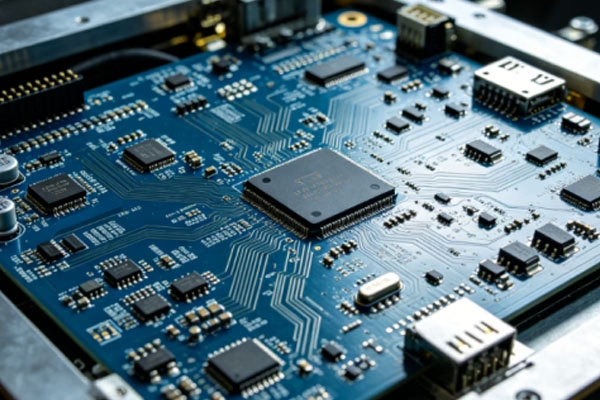
Aerospace PCBs Demand Extremely High Levels of Reliability and Safety
In high-risk operational environments, PCBs must possess the capability to function stably over prolonged periods.
1. Aerospace Systems Prioritize High-Reliability Operations
- Flight control and satellite communication systems require PCBs to maintain consistent performance throughout extended operational durations.
- Design processes typically incorporate redundant structures to mitigate the risk of system failure.
2. Military and Aerospace Standards Are Rigorous
- PCB manufacturing must strictly adhere to relevant standards such as IPC, MIL, and AS9100.
- Components and materials typically utilize military-grade specifications to enhance overall system reliability.
High-reliability design capability constitutes a fundamental cornerstone of aerospace PCB solutions.
Complex Environments Impose Heightened Demands on PCB Structures and Materials
In extreme environments, PCBs must demonstrate robust resilience against environmental stressors.
1. High/Low Temperatures and Vibration Present Significant Challenges
- Aerospace equipment is subjected to drastic temperature fluctuations, necessitating high stability in PCB laminates.
- The flight and launch phases involve intense vibration environments, requiring enhanced structural integrity and solder joint reliability.
2. Radiation and Humidity Issues Require Critical Control
- Satellite platforms necessitate radiation-hardened designs to minimize the impact of space radiation on circuitry.
- Protective coatings are typically applied to PCB surfaces to mitigate risks associated with moisture and contamination.
Maintaining stability within complex environments represents a critical design imperative for aerospace PCBs.
High-Performance Materials and Specialized Processes Emerge as Key Components
In aerospace systems, standard PCB materials are often insufficient to meet the demands of long-term operational requirements.
- Common materials include high-temperature laminates, FR408, and high-performance resin materials.
- Protective coatings and highly reliable surface treatment processes enhance the PCB’s corrosion resistance and long-term stability.
Material selection and process schemes directly impact the PCB’s lifespan and stability.
High-Speed Signaling and Electromagnetic Compatibility: Key Design Priorities
Modern satellite platforms are evolving toward high-speed data processing capabilities.
- High-speed communication modules impose stringent requirements on impedance control and signal integrity.
- High-frequency sections necessitate enhanced shielding and isolation designs to mitigate EMI interference.
Robust signal integrity and effective EMC control are critical performance metrics for PCBs in modern aerospace satellite platforms.
Comparison Table of Key Technologies for Aerospace Satellite Platform PCBs
| Technical Dimension | Aerospace PCB Performance | Key Application Scenarios | Key Design Focuses |
| Reliability Requirements | Long-term Stable Operation | Satellites and Flight Control Systems | Redundant Design & Military-Grade Standards |
| Environmental Adaptability | High and Low Temperature Resistance; Vibration Resistance | Rocket Launch and Space Environment | Structural Stability |
| Radiation Hardness | Space Radiation-Resistant Design | Satellite Electronic Systems | Component & Material Protection |
| Material Selection | High-Tg Materials; High-Performance Resins | High-Frequency and High-Temperature Modules | Thermal Stability |
| Surface Treatment | Protective Coatings; High-Reliability Processes | Long-Life Systems | Corrosion Resistance & Reliable Connectivity |
| High-Speed Signal Design | High-Frequency, High-Speed Links | Satellite Communication Modules | Signal Integrity & EMC Control |
The development of PCB solutions for aerospace satellite platforms is continuously evolving toward higher reliability, greater integration, and enhanced adaptability to complex environments. In flight control, satellite communication, and space electronic systems, PCBs have emerged as a critical foundational platform that determines overall system stability. Faced with multifaceted challenges—including thermal cycling, vibration and shock, space radiation, and high-speed signal transmission—PCBs require a high degree of synergy across their materials, structure, manufacturing processes, and electrical design. Through a systematic analysis of key technologies and design complexities, one can gain a more comprehensive understanding of the core value that aerospace PCBs hold within modern space electronics architectures.