
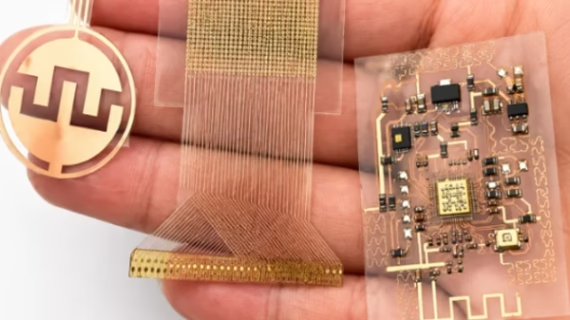
As electronic products continue to evolve toward thinner, lighter, and higher integration, flexible printed circuit boards (FPCs) have become a critical component in modern electronics manufacturing. Among them, the double-sided conductive flexible PCB (FPC double-sided board) is widely used in consumer electronics, medical devices, automotive electronics, industrial control systems, and communication products due to its ability to route circuits on both sides of a flexible substrate while maintaining high wiring density, spatial efficiency, and structural flexibility.
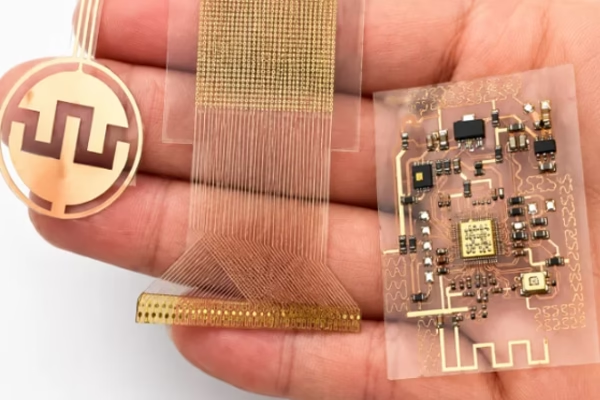
Compared with single-sided FPCs, double-sided FPCs provide more routing space and are better suited for designs with moderate to high circuit complexity. They also support lightweight, thin structures while maintaining reliability and flexibility. For many product designers, the value of FPC double-sided boards is not only “bendability,” but also stable interconnection in limited space, reduced connector usage, optimized assembly paths, and a more compact system structure.
What Is a Double-Sided Conductive Flexible PCB (FPC Double-Sided Board)?
What is a flexible printed circuit board?
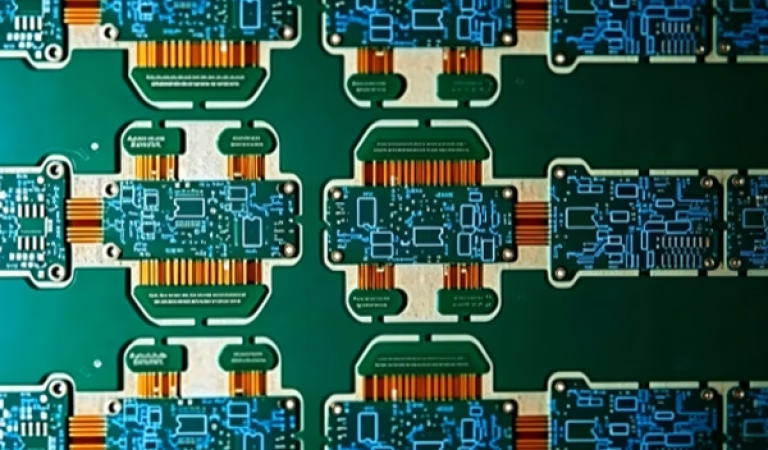
A flexible printed circuit board (FPC) is a type of circuit board that forms conductive traces on a flexible substrate. Unlike traditional rigid PCBs, FPCs can be bent, folded, or routed across 3D spaces according to product structural requirements without being limited to a flat form factor. This flexibility makes FPCs essential for modern compact and highly integrated electronic devices.A double-sided FPC has conductive traces on both sides of the flexible substrate, connected through vias. Compared with single-sided FPCs, it provides higher routing flexibility and supports more connection points and circuit paths, making it suitable for more complex electronic designs.
Characteristics of FPC double-sided boards
FPC double-sided boards feature high wiring density, lightweight structure, thin profile, excellent flexibility, and strong adaptability. They enable high integration in extremely limited space, reduce connectors and wire harnesses, and improve overall system reliability. For miniaturized and lightweight products, FPCs are not only a structural optimization solution but also a key enabler of functional integration.
| Feature | Description |
| Double-sided routing | Traces on both sides increase routing flexibility |
| Lightweight | Thin and light, ideal for compact devices |
| Flexible | Adapts to complex installation paths |
| High integration | Reduces connectors and interconnect parts |
| High adaptability | Supports static and dynamic bending |
Performance characteristics of FPC
FPCs are not only “thin and flexible,” but also offer excellent electrical and mechanical performance. The substrate is typically polyimide (PI), which provides high thermal resistance and stability, making it suitable for soldering and high-temperature assembly processes. For double-sided FPCs, trace precision, copper adhesion, via quality, and coverlay protection directly affect product performance and lifespan.
Application industries of FPC
FPC double-sided boards are widely used in industries where space, weight, and reliability are critical. Common applications include smartphones, tablets, camera modules, automotive dashboards, medical devices, industrial controllers, wearable electronics, and communication modules.
| Industry | Applications |
| Consumer electronics | Phones, tablets, camera modules, printers |
| Automotive electronics | Instrument clusters, control modules, sensors |
| Medical devices | Monitoring equipment, portable diagnostic devices |
| Industrial control | Sensors, control terminals |
| Communication | Antenna modules, RF modules |
| Wearables | Smartwatches, fitness trackers |
How Is a Double-Sided FPC Produced?
Requirement analysis and design planning
The manufacturing process starts with requirement definition rather than layout drawing. Engineers must define circuit complexity, bending method, installation space, interface type, operating environment, and whether dynamic flexing is required. For double-sided FPCs, both electrical routing and mechanical layout must be considered simultaneously.
Pattern formation and circuit fabrication
The production process includes substrate preparation, copper lamination, exposure, development, etching, drilling, via metallization, coverlay lamination, and profiling. Compared to single-sided boards, double-sided FPCs require precise alignment between both layers and reliable via interconnection.
Lamination and protection layer processing
Coverlay is used as a protective layer for FPCs, protecting circuits from abrasion, moisture, dust, and mechanical stress. During lamination, uniform bonding without bubbles or misalignment is critical. Openings must be reserved for component soldering areas.
Electrical testing and reliability inspection
Finished FPCs undergo continuity testing, visual inspection, and bend testing. High-reliability products may also require impedance testing, thermal testing, and environmental stress tests. Long-term stability is as important as basic conductivity.
| Manufacturing step | Function |
| Requirement analysis | Define function and structure |
| Circuit formation | Create conductive patterns |
| Via processing | Enable interlayer connection |
| Coverlay lamination | Protect circuits |
| Profiling | Match product shape |
| Electrical testing | Ensure performance stability |
How to Optimize FPC Double-Sided Boards?
Circuit design considering bending and electrical performance
Circuit design must account for mechanical stress in bending areas. Sharp angles and overly dense routing should be avoided. Copper fatigue must be considered, especially in dynamic bending applications. Improper design may lead to cracking or intermittent failure over time.
Via interconnection and quality control
Via quality is critical for double-sided FPCs. Poor plating or misalignment may cause open circuits or unstable resistance. Due to the thin and flexible nature of materials, drilling and plating require tighter process control than rigid PCBs.
Coverlay and reinforcement design
Coverlay protects circuits and improves insulation and moisture resistance. Reinforcement materials are often added at connector or soldering areas to enhance mechanical strength and prevent deformation during assembly or insertion.
Technical optimization table
| Optimization area | Method | Benefit |
| Bending design | Control bend radius, avoid sharp angles | Improve durability |
| Routing balance | Even distribution on both sides | Enhance stability |
| Via control | Precise drilling & plating | Reliable interconnection |
| Coverlay protection | Surface protection layer | Wear & moisture resistance |
| Reinforcement | Add stiffener at key areas | Improve mechanical strength |
| Impedance control | Line width & spacing control | Better signal performance |
Why double-sided FPC is suitable for medium-to-high complexity designs
Single-sided FPCs are suitable for simple connections, while double-sided FPCs are better for higher circuit density and more complex module integration. They provide more routing space without increasing board size, making them ideal for compact electronic systems.
What Materials Are Used in FPC Double-Sided Boards?
Flexible substrate materials
The most commonly used substrate is polyimide (PI), known for excellent thermal resistance, flexibility, and mechanical stability. PI can withstand soldering temperatures and repeated bending cycles, making it ideal for dynamic applications.
Conductor materials
Copper foil is typically used as the conductor. Electro-deposited copper is suitable for general applications, while rolled annealed copper offers better flexibility and fatigue resistance, making it ideal for dynamic bending environments.
Protection and auxiliary materials
Coverlay is widely used as a protective layer for FPCs, providing insulation and mechanical protection. Reinforcement materials are also used in areas requiring mechanical support.
| Material area | Common material | Function |
| Flexible substrate | PI (Polyimide) | Flexibility & thermal resistance |
| Conductor | Electro-deposited / RA copper | Signal transmission |
| Protective layer | Coverlay | Insulation & protection |
| Reinforcement | FR4 / PI stiffener | Mechanical support |
| Adhesive | Specialized bonding materials | Layer bonding stability |
Material selection depends on application environment
Material selection should not be based on “higher grade is better,” but rather on application requirements. Consumer electronics focus on thinness and cost, medical devices prioritize stability and safety, automotive applications require temperature and vibration resistance, and industrial systems focus on durability and signal reliability.
What are the advantages of FPC double-sided boards compared to rigid PCBs?
Many customers ask about the difference between FPC double-sided boards and traditional rigid PCBs. The key difference is flexibility and space adaptability. Rigid PCBs offer structural stability but cannot bend, making them unsuitable for complex 3D assemblies. FPC double-sided boards, however, can bend, fold, and route across tight spaces while maintaining good electrical performance.They reduce connectors and wiring harnesses, simplify assembly, and improve overall system reliability. For space-constrained and compact products, FPCs are not just components—they are a design enabler for lighter, smaller, and more flexible product architectures.
Why choose Topline Circuit for FPC double-sided board manufacturing?
Founded in 2000 and headquartered in Shenzhen, China, Topline Circuit is an electronic solution provider offering PCB layout, manufacturing, assembly, testing, and validation services. Our product portfolio includes high-reliability flexible PCBs, rigid-flex boards, RF/microwave PCBs, HDI PCBs, and rigid PCBs. As a recognized technology leader, we provide fast turnaround times with fully in-house production, offering a true one-stop service experience. Our products are widely used in government, medical, instrumentation, aerospace, industrial, and communication industries.
If your project requires lightweight design, compact structure, and high-reliability interconnection, feel free to send us your specifications, dimensions, material requirements, and application details. We will provide tailored engineering recommendations and quotation support to help you move smoothly from design to mass production.Email: sales@toplinecircuit.com