


In smart medical devices, a PCB is not just a component that “conducts electricity.” It functions more like the neural center of the entire system. Patient monitors, ultrasound equipment, wearable medical terminals, and in vitro diagnostic instruments all require extremely high levels of stability, durability, and consistency. Therefore, reliability testing for medical PCBs is not a single procedure but a comprehensive validation covering design, manufacturing, assembly, cleanliness, environmental stress, and electrical performance.In the medical device industry, the most commonly used quality system standard is ISO 13485. For device safety and basic performance, the IEC 60601 series is the core reference. Meanwhile, PCB design, fabrication, assembly, and acceptance are typically evaluated based on relevant IPC standards.
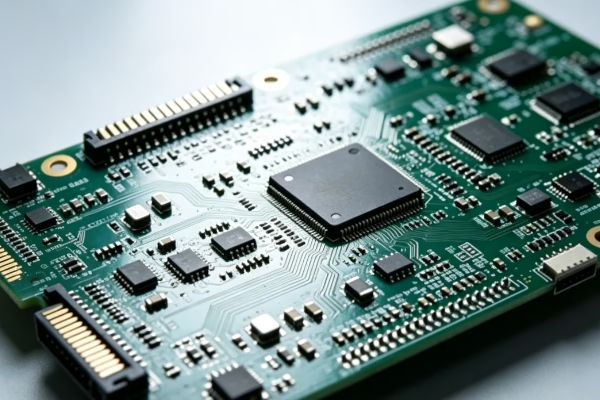
What is Reliability Testing for Smart Medical PCBs?
Reliability testing, in simple terms, is used to determine whether a PCB can operate stably under long-term use, repeated operation, and complex environments.It is not only about checking “whether it works now,” but also about confirming whether it can maintain normal performance under high and low temperature cycles, humidity, vibration, repeated plugging and unplugging, solder joint stress, cleaning residue, and electromagnetic interference.This is particularly critical for medical devices, because any failure may affect not only product performance but also diagnostic and treatment safety.
The IEC 60601 series focuses on basic safety and essential performance, and IEC 60601-1-2 specifically addresses electromagnetic compatibility (EMC) requirements. IPC standards, on the other hand, provide frameworks for rigid boards, flexible boards, assembly, and inspection acceptance. Medical applications may also reference the medical appendix of IPC-6012.From an industry perspective, medical PCB reliability testing is not a one-time task. It runs through the entire lifecycle: design defines the rules, fabrication focuses on materials and structure, assembly verifies solder quality, and final products undergo environmental and functional validation.
Within IPC standards:
IPC-2221 defines general design requirements
IPC-6012 covers qualification and performance of rigid boards
IPC-6013 applies to flexible boards
IPC-A-600 defines acceptability of printed boards
J-STD-001 defines soldering and assembly requirements
TM-650 provides detailed test methods
How is Medical PCB Reliability Testing Performed?
The following process reflects the typical workflow from prototype to mass production of medical electronics. It begins with design review, followed by incoming material inspection and process verification, then assembly validation, environmental stress testing, and final functional evaluation.This approach ensures that issues are detected early rather than after full system assembly.IPC standards are structured around design, manufacturing, acceptance, and testing, while ISO 13485 requires a full lifecycle quality management system for medical devices.
Process Overview
| Stage | Main Purpose | Typical Checks |
| Design Review | Prevent risks early | Trace spacing, stack-up structure, creepage distance, via/impedance design, component layout |
| Incoming Inspection | Ensure material reliability | Substrate certification, batch traceability, copper foil/solder mask/surface finish confirmation |
| Manufacturing Inspection | Control fabrication defects | AOI, X-ray, cross-section, hole plating, solder joint quality, cleanliness |
| Environmental Testing | Simulate real usage conditions | Thermal cycling, humidity, vibration, aging, functional retesting |
| Final Evaluation | Confirm deliverability | Electrical testing, appearance inspection, dimensional check, reliability records, traceability documents |
This is not simply “adding more inspection steps.” It is a complete integration of design standards, fabrication standards, soldering standards, and test methodologies.
For example:
IPC-A-600 evaluates board acceptability
J-STD-001 evaluates solder quality
TM-650 provides specific test methods
Medical applications may further adopt the IPC-6012 medical appendix to raise reliability requirements
How to Improve Reliability Testing Quality?
The real differentiation is not whether testing is performed, but whether testing truly covers real-world risks.Common failure modes in medical PCBs include via barrel cracking, interlayer separation, solder joint fatigue, ionic contamination, solder mask cracking, thermal stress deformation, and insufficient electrical clearance.TM-650 includes chemical, mechanical, electrical, and environmental test methods. J-STD-001 emphasizes soldering reliability, especially under vibration and thermal cycling, where interconnect stability is critical.
Key technical focus areas include:
· Representative Sampling
Samples must be evaluated in batches—prototypes, first articles, small batches, and mass production boards must not be mixed. For medical products, batch consistency is more important than individual sample performance.
· Realistic Thermal Stress Testing
Medical devices often operate continuously, generate localized heat, and undergo frequent power cycling. Therefore, thermal cycling and humidity testing are essential. IEC 60601 emphasizes not only electrical continuity but also stable operation under interference and environmental variation.
· Cleanliness Control
Residual flux and ionic contamination can affect insulation reliability. J-STD-001 defines clear cleanliness requirements, and TM-650 provides ROSE testing methods to evaluate cleanliness levels.
· Combined Visual and Cross-Section Analysis
Some defects are not visible to the naked eye. Cross-sectioning, microscopic inspection, and interlayer structure analysis provide a more accurate assessment. IPC-A-600 uses visual standards to define target, acceptable, and non-conforming conditions.
What Materials Are Suitable for Medical PCBs?
Material selection determines not only testing difficulty but also long-term reliability.For rigid boards, IPC-4101 is commonly used as the base material specification. For flexible and rigid-flex boards, IPC-6013 defines more suitable structural requirements.Medical devices select materials based on thermal performance, electrical insulation, dimensional stability, moisture resistance, and assembly requirements. Reliability is therefore not a post-process correction—it begins with material selection.
| Material / Component | Application Scenario | Key Considerations |
| High-performance rigid substrate | Monitors, control boards, main signal boards | Dimensional stability, heat resistance, insulation reliability |
| Flexible substrate | Portable devices, wearables, foldable structures | Flexibility, fatigue resistance, interlayer adhesion |
| Rigid-flex materials | Compact systems with complex routing | Mechanical strength, bending life, assembly compatibility |
| Solder mask & surface finish | Soldering, protection, long-term storage | Chemical resistance, solderability, consistency |
| Adhesives / reinforcement materials | Structural reinforcement | Thermal resistance, moisture resistance, long-term stability |
For high-density, miniaturized, or high-frequency medical products, electrical and thermal performance must be considered together. IPC design standards ensure that material selection, structural design, and manufacturing validation are aligned, reducing rework during testing.
Why Do Medical PCBs Require So Many Reliability Tests?
Because medical devices are not only expected to “work in prototypes,” but must remain stable and consistent across mass production.Comprehensive testing helps detect design flaws, material mismatches, solder defects, delamination, and contamination early in the process.For customers, this means lower delivery risk, reduced repair rates, smoother system validation, and easier certification and mass production approval.ISO 13485 emphasizes system-level quality control, IEC 60601 focuses on safety and essential performance, and IPC standards ensure detailed implementation across design, manufacturing, assembly, and acceptance.
Reliability testing for smart medical PCBs is essentially about one principle: preventing problems before shipment and containing risks within the laboratory stage.
In medical applications, a PCB is not a standard electronic component. It must withstand time, temperature, humidity, vibration, and long-term power operation while meeting strict requirements across design, manufacturing, assembly, and testing.When standards are correctly selected, processes are properly controlled, and materials are appropriately chosen, product stability improves significantly and mass production becomes more reliable.For customers, what truly matters is not claims of expertise, but whether every step is executed rigorously—ensuring each board is traceable, verifiable, and deliverable.Founded in 2000 and headquartered in Shenzhen, China, Toplay Circuit is a one-stop electronic solution provider specializing in PCB layout, manufacturing, assembly, testing, and validation. Its services cover prototyping, mass production, SMT/DIP assembly, testing, and delivery.
From engineering review to shipment, the company focuses on quality control and delivery reliability. From design to manufacturing, assembly, and testing, communication is kept clear and execution remains efficient. For customers aiming to transition quickly from prototype to mass production, such a one-stop approach helps streamline projects and improve overall product success.