
Price and delivery time are easy to compare. Assembly risk is harder to see before production starts.
Many problems appear only after the first build. These problems may include missing BOM data, wrong part rotation, weak solder joints, or unclear test steps.
For engineers and purchasing teams, the quotation is only one part of the decision. The project files, component sourcing, process control, inspection plan, and test method also matter.
Check the Files Before the Build Starts
A PCB assembly project needs clear files. Gerber files show the PCB structure, but they do not explain every assembly detail.
The supplier also needs the BOM, pick-and-place file, assembly drawing, and test requirements. These files help prevent wrong placement, wrong sourcing, and production delays.
The BOM needs special attention. It should include part numbers, quantities, packages, and reference designators. Approved substitutes should also be listed if they are allowed.
| Project File | Purpose | What to Check |
|---|---|---|
| Gerber files | Show PCB layers and board outline | Layer count, drill files, solder mask, board profile |
| BOM | Controls sourcing and placement | MPN, quantity, package, reference designator |
| Pick-and-place file | Guides SMT placement | X/Y position, rotation, assembly side |
| Assembly drawing | Shows build details | Polarity, connector direction, special notes |
| Test requirements | Defines final checks | ICT, functional test, programming, pass limits |
If these files are unclear, the supplier has to ask questions. If questions are missed, the supplier may make assumptions. That can lead to rework.
Make Sure the Process Fits the Board
Not every PCB needs the same assembly process. A simple SMT board is different from a dense board with BGAs, QFNs, connectors, and through-hole parts.
For SMT assembly, solder paste printing must be stable. Fine-pitch parts need accurate paste volume. Small passive parts need clean stencil release.
Component placement also needs review. Wrong rotation can happen when the pick-and-place file is not checked. It can also happen when polarity marks are unclear.
Mixed assembly adds more risk. Through-hole parts may need wave soldering, selective soldering, or hand soldering. Large connectors may also need fixture support.
Review the BOM Before Purchasing Parts
Component sourcing can delay the project. This can happen even when assembly capacity is ready.
Some parts may be out of stock. Some parts may be obsolete. Some parts may only be available from risky sources.
A BOM review should check stock, lifecycle, package, and approved substitutes. Any substitute should be approved before purchasing. A wrong substitute can affect fit, rating, or product performance.
For industrial products, traceability also matters. Buyers should ask how parts are sourced, stored, and inspected before assembly.
Control the Main Assembly Steps
Process control affects first-pass yield. A clean build is not only about good machines. It also depends on stable process settings.
Solder paste printing is the first key step. Too much paste can cause bridges. Too little paste can cause opens or weak joints.
Placement is the next key step. The machine must place each part in the right position and direction. Library data and feeder setup should be checked before the run.
Reflow soldering also needs control. The profile must fit the board and component mix. Large copper areas and heavy parts can change heat flow.
Use the Right Inspection Method
Visual inspection is not enough for many PCB assemblies. Some defects are visible. Some defects are hidden under components.
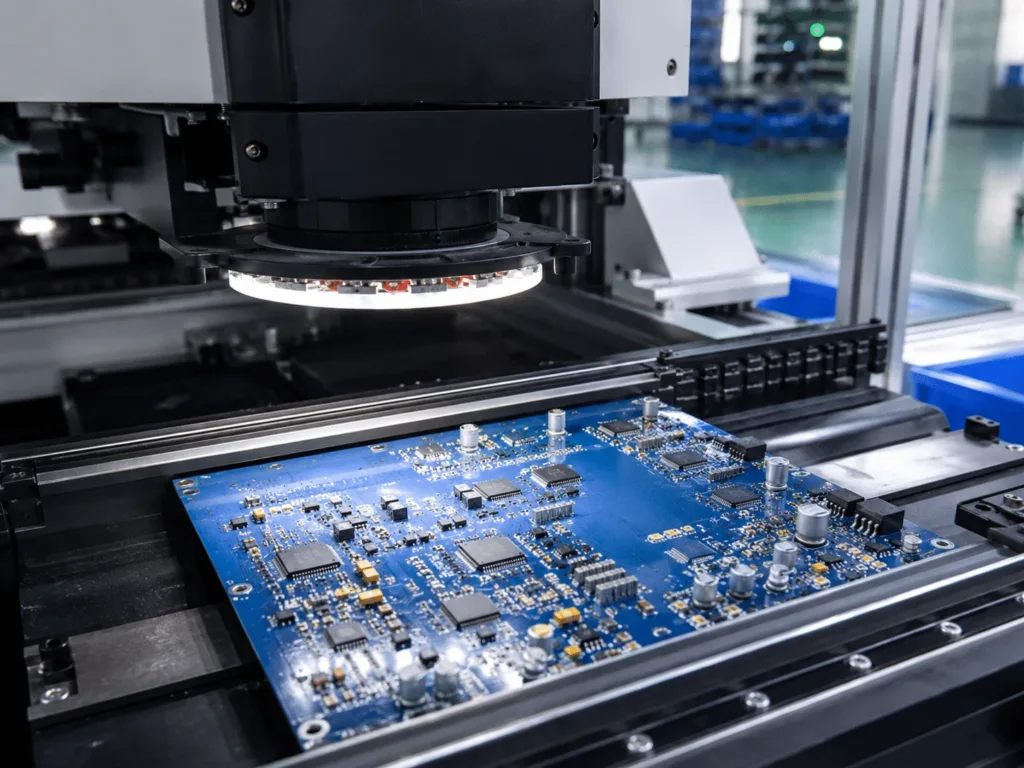
AOI inspection can find missing parts, wrong polarity, solder bridges, tombstoning, and shifted parts. It works well for many SMT boards.
X-ray inspection is needed for hidden solder joints. It is useful for BGA, QFN, LGA, and other bottom-terminated packages.
| Inspection Method | What It Checks | Best Use |
| SPI | Solder paste volume and position | Fine-pitch parts and dense SMT boards |
| AOI inspection | Visible placement and solder defects | Standard SMT assembly |
| X-ray inspection | Hidden solder joints | BGA, QFN, LGA packages |
| First article inspection | First build accuracy | New products and prototype builds |
| ICT | Circuit connection issues | Repeat production |
| Functional testing | Product-level operation | Boards with firmware or power circuits |
Inspection should not stop at finding defects. It should also help trace the cause. This prevents the same problem from coming back.
Confirm the Test Plan Early
Testing should be discussed before quotation. If the test method is unclear, the cost and schedule may not be accurate.
Some boards only need visual inspection and AOI inspection. Other boards need programming, power-on testing, signal checks, or functional testing.
The test plan should include clear pass and fail limits. Voltage, current, firmware version, LED status, and communication results should be defined.
Clear testing reduces disputes. It also helps confirm if the assembly is ready for repeat production.
Check How Defects Are Handled
A machine list does not show how a factory handles defects. The real question is how problems are tracked and corrected.
When a defect appears, the team should find the source. It may come from the BOM, stencil, placement file, reflow profile, part quality, or handling.
Rework should also be recorded. Repeated defects should trigger process changes. This is more useful than a simple pass or fail report.
This matters more when volume increases. A small issue in 10 boards can become costly in 1,000 boards.
Review Support from Prototype to Production
The first build should give useful feedback. It should not be treated as a one-time order.
Prototype assembly can reveal missing data, wrong footprints, sourcing risks, and weak test plans. These issues should be fixed before larger production runs.
Good production support includes DFM review, BOM review, sourcing checks, assembly review, and first article feedback. These steps help reduce delays and rework.
For engineering review and quotation support, please send your Gerber files, BOM, assembly drawings, and quantity requirements to sales@toplinecircuit.com.
Planning Your Project
Choosing a printed circuit board assembly supplier should not depend only on price. Buyers should also check files, sourcing, process control, inspection, testing, and production support.
Before sending an order, prepare the Gerber files, BOM, pick-and-place file, assembly drawing, test requirements, and expected quantity. Clear data helps the supplier quote more accurately. It also reduces mistakes before the first build starts