


As server systems evolve towards high-density computing and high-reliability operation, the choice of PCB materials has become a crucial factor influencing overall performance. Whether in cloud computing data centers or enterprise-level server clusters, PCBs require stable electrical performance and thermal management capabilities during long-term operation. Materials determine signal transmission loss and directly affect heat dissipation efficiency, mechanical strength, and system lifespan. In applications with both high-speed signals and high power consumption, the combination of different materials has become the mainstream approach, achieving a balance between performance and cost through layered design. Analyzing common material types and their application characteristics helps to better understand the key decision-making logic in server PCB manufacturing.
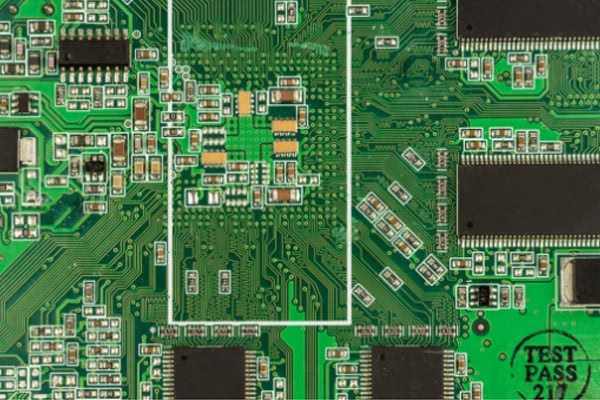
FR4 Material is the Most Basic and Widely Used Choice in Server PCBs
FR4 still holds a core position in standard server motherboard manufacturing.
- FR4 offers excellent cost advantages and manufacturing stability: it is suitable for most general-purpose server circuit boards.
- It performs stably in low-to-medium speed signal environments: it can meet basic computing and storage requirements.
This material is mainly used in the motherboard’s base layer structure and is an important component of server PCB cost control.
Rogers and Polyimide Materials for High-Speed and High-Temperature Environments
In high-speed signal and high-frequency applications, the requirements for material performance are significantly increased.
- Rogers materials possess low dielectric loss characteristics, making them suitable for high-speed signal transmission layers such as 112G/224G.
- Polyimide exhibits excellent heat resistance, making it suitable for high-temperature operating environments and complex multilayer structures.
These materials are primarily used in high-speed signal layers and critical functional areas.
Metal-Core PCBs for High-Power and Heavy-Duty Heat Dissipation Scenarios
In high-power server applications, heat dissipation becomes a critical limiting factor.
- Metal-core structures can significantly improve thermal conductivity, effectively reducing local hotspot temperatures.
- Suitable for high-heat-density applications such as GPU servers and power modules.
This solution primarily enhances heat dissipation capabilities and improves long-term system stability.
Material Combination Design is a Key Strategy for Improving Overall Reliability
In complex server systems, a single material cannot meet all requirements.
- Multi-material stack-up designs can simultaneously address high-speed signal performance and cost control needs.
- By selecting materials in specific zones, the functions of the power layer, signal layer, and heat dissipation layer can be optimized.
This combination significantly improves the overall engineering adaptability of server PCBs.
Comparison Table of Commonly Used Server PCB Materials
| Material type | Main features | Application scenarios | Key advantages |
| FR4 | Low cost, mature processing | Standard server motherboard | High cost-performance ratio and good stability |
| Rogers | Low dielectric loss, excellent high-frequency performance | High-speed signal layer | Supports 112G/224G high-speed transmission |
| polyimide | High temperature resistance, combining flexibility and stability | Multi-layer high-speed PCB structure | Excellent heat resistance |
| Metal Core PCB | High thermal conductivity | High-power/heavy-load server module | Strong heat dissipation capacity |
The development of server PCB material solutions is essentially a comprehensive balancing act between performance, heat dissipation, and reliability. In environments where high-speed computing and long-term stable operation coexist, material selection is no longer a simple matter of cost, but a crucial component of system-level performance design. Different materials have different strengths in electrical performance, thermal management, and mechanical structure, and their appropriate combinations can effectively improve the overall system’s adaptability. As servers evolve towards higher bandwidth and higher power consumption, the importance of materials engineering will further increase, continuously driving the evolution of PCB manufacturing technology to higher levels.