


Against the backdrop of ever-increasing AI computing demands, server hardware architecture is undergoing significant upgrades, with PCBs, as the core platform, experiencing a corresponding increase in complexity and technical barriers. PCB solutions for AI servers and high-performance computing (HPC) are no longer limited to traditional server board designs, but are deeply optimized around computing density, data throughput, and stable operation. Whether it’s GPU clusters for large model training or acceleration nodes for real-time inference, higher standards are being placed on PCBs, such as higher layer counts, finer routing, and more stringent electrical performance control. Simultaneously, the continuous evolution of chip packaging forms and interface speeds is driving a comprehensive upgrade of PCB design from structure to materials, making it a crucial foundational element determining overall system performance. An analysis focusing on industry applications, layer count and HDI requirements, and core design challenges, combined with a structured comparison table, helps to clarify the development direction and key technologies of AI server PCBs.
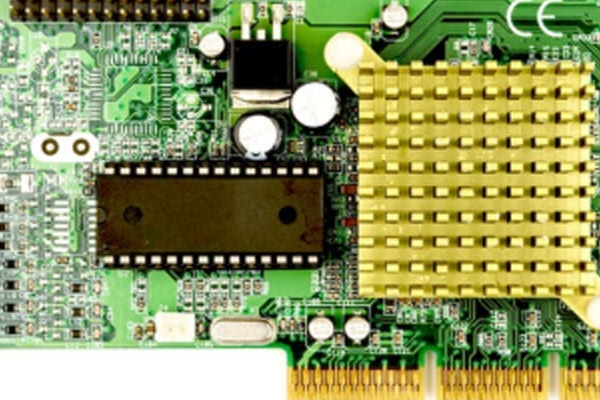
Industry Application Scenarios Highlight Differentiated Characteristics of PCB Solutions
Driven by different computing tasks, PCB design exhibits a clear application orientation.
- AI training and inference scenarios have extremely high requirements for computing density, requiring PCBs to support multi-GPU or ASIC collaborative operation while ensuring stable power supply and high-speed interconnection.
- In the field of high-performance computing, data processing capabilities and parallel computing efficiency are emphasized. PCB design must balance multi-node communication and low-latency signal transmission.
Differences in application requirements lead to targeted optimization directions in PCB structure and layout.
Layer count and HDI (High-Density Interconnect) structures have become important indicators for measuring PCB complexity
At the structural design level, high layer count and high density have become core development trends.
- AI server PCBs typically start with 24 layers, with high-end products reaching over 40 layers to meet the routing requirements of complex signal and power networks.
- Extensive use of HDI structures, through micro-blind vias and fine linewidths, increases routing density while optimizing signal paths.
The combination of layer count and HDI technology enables PCBs to support highly complex systems.
Core design challenges are concentrated in three main areas: power consumption, packaging, and signal performance
In actual design, multiple technical challenges need to be addressed simultaneously.
- The significantly increased heat dissipation pressure brought by ultra-high power consumption necessitates the introduction of efficient heat dissipation designs in PCBs, such as optimized copper thickness and thermal via placement.
- GPUs and ASICs utilize large-size BGA packages, leading to complex routing and placing higher demands on fan-out design and inter-layer connectivity.
These multiple challenges combine to demand greater experience and technical expertise from PCB designers.
High-speed signal integrity becomes a critical factor affecting system stability
In high-speed data transmission environments, signal quality directly impacts system performance.
- High-speed interfaces (such as PCIe and SerDes) have stringent requirements for impedance control and crosstalk suppression, necessitating consistent and continuous routing.
- The complex signal paths in multi-layer structures necessitate simulation and optimization to reduce losses and reflections, ensuring reliable data transmission.
The ability to optimize signal integrity is a crucial standard for evaluating high-end PCB design capabilities.
Comparison Table of Key Aspects of AI Servers and HPC PCBs
| Dimension | AI Training/Inference PCB | High-performance computing (HPC) PCB | Technical Focus |
| Application characteristics | Multi-GPU/ASIC parallel computing | Multi-node collaboration and highly parallel computing | Computing density, data throughput |
| Layer structure | Starting from 24 floors, 40 floors and above are common. | Mainly floors 20-36 | Wiring complexity, power integrity |
| HDI Applications | Extensive use of micro-blind vias and high-density interconnects | Medium to high proportion of HDI used | Wiring density, signal path optimization |
| Packaging | Large-size BGA (GPU/AI chips) | Hybrid CPU/GPU packaging | Fan-out capability, soldering reliability |
| Heat dissipation requirements | Extremely high power consumption, requiring enhanced thermal design | High power consumption but relatively balanced distribution | Thermal management, material selection |
| Signal Integrity | High-speed SerDes and PCIe high-frequency signals | High-speed interconnect and node communication | Impedance control, crosstalk suppression |
AI servers and high-performance computing PCB solutions are continuously evolving towards higher density, higher speed, and higher reliability. The design process requires striking a balance between the number of layers, materials, structure, and heat dissipation, while also considering manufacturing feasibility and cost control. Faced with ever-increasing computing power demands and chip integration, the PCB is no longer just a connecting carrier, but a key component deeply involved in achieving system performance. Through structured analysis and comparison, we can more intuitively understand the differences in PCB design priorities under different application scenarios, thus providing a clearer reference path for product development and technology selection.