


In defense-grade communication control systems, PCBs are not only carriers for circuit connections but also the critical foundation that determines system stability, anti-interference capability, environmental adaptability, and long-term reliability. For application scenarios such as radar communications, command and control systems, encrypted terminals, vehicle-mounted communications, shipboard control systems, and airborne equipment, PCB solution design cannot focus solely on “whether it powers on.” More importantly, it must ensure “long-term stable operation under high temperature, vibration, shock, humidity, and complex electromagnetic environments.”
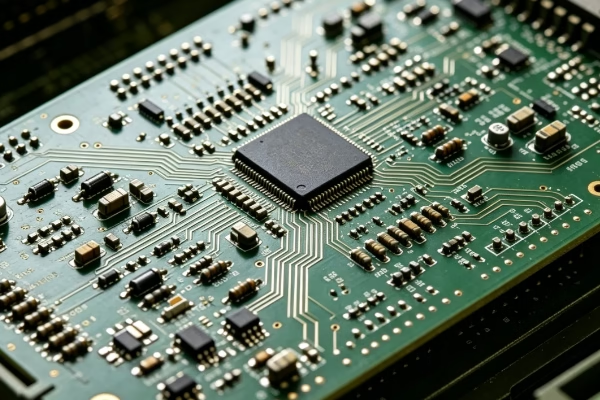
What Is a Defense-Grade Communication Control System PCB Solution?
A defense-grade communication control system PCB solution refers to a circuit board solution designed for highly reliable communication and control equipment. Its core objective is not simply low cost, but rather high reliability, high stability, long service life, and strong environmental adaptability.
Such PCBs typically must meet requirements including:
- Complex signal transmission
- Strict electromagnetic compatibility (EMC)
- Continuous operation
- Traceable manufacturing
- Highly consistent assembly quality
Core Characteristics of This Type of PCB
| Core Feature | Meaning | Typical Function |
| High Reliability | Operates for long periods without failure | Ensures uninterrupted communication |
| Strong Anti-Interference Capability | Resists external electromagnetic noise | Ensures accurate command transmission |
| High Environmental Adaptability | Resistant to heat, humidity, and vibration | Adapts to complex battlefield conditions |
| Strong Manufacturability | Stable for mass production | Reduces rework risk |
| Good Testability | Easy for ICT/FCT/burn-in testing | Improves delivery consistency |
These PCBs are commonly used in:
- Communication main control boards
- RF control modules
- Power management modules
- Data acquisition modules
- Interface conversion modules
- Embedded computing units
They must achieve high-density routing within limited space while maintaining signal integrity and system safety. Therefore, solution design often begins at the system architecture stage rather than being addressed later as a corrective measure.
How Are Defense-Grade Communication Control System PCB Solutions Developed?
Defense-grade communication control system PCB solutions are usually not completed in a single step but are developed progressively through a structured process.
The workflow generally includes:
- Requirement definition
- Schematic design
- PCB layout and routing
- Prototype fabrication
- Assembly and testing
- Reliability validation
- Mass production introduction
Each stage directly impacts final performance, and any oversight may lead to future failures.
Solution Implementation Process
| Process Stage | Main Tasks | Output |
| Requirement Definition | Define voltage, frequency, interface, and environmental requirements | Design input documentation |
| Circuit Design | Complete schematics and component selection | Electrical logic solution |
| PCB Layout & Routing | Plan stack-up, routing, impedance, and isolation | Manufacturable PCB files |
| Prototype Manufacturing | Conduct first article production and process validation | Physical prototype boards |
| Assembly & Testing | SMT/DIP soldering and functional testing | Functional prototype |
| Reliability Validation | Burn-in, vibration, thermal cycling, EMC testing | Validation reports |
| Mass Production Delivery | Finalize processes and begin production | Stable production delivery |
The most critical aspect during implementation is “early-stage collaboration.” In other words, design engineers, manufacturing engineers, and test engineers should confirm the solution together as early as possible.
Defense-grade communication control systems often have strict requirements regarding:Layer count、Impedance control、Hole size、Pad dimensions、EMI shielding、Thermal design.
If the design only considers circuitry without manufacturing and assembly requirements, significant rework may occur later in production.How to Optimize Technical Details for Defense-Grade Communication Control System PCBsThe true challenge is not simply “creating the PCB,” but ensuring “stable mass production and long-term reliability.”
Technical details usually focus on the following areas:
Structural Design Must Balance Signal Integrity and Safety.Communication control systems often contain:High-speed digital signals、RF signals、Power signals.High-speed traces require impedance control, RF traces must minimize loss, and power lines must reduce voltage drop and noise.At the same time, different functional areas must be isolated to prevent digital noise from affecting communication links.
Common approaches include:
- Partitioned layout
- Continuous ground planes
- Short routing paths for sensitive signals
- Placing critical components close to connectors
Stack-Up Design Determines System Stability
Multilayer boards are commonly used for these applications.
A well-designed stack-up can:
- Improve return current paths
- Reduce crosstalk
- Enhance anti-interference capability
For high-frequency communication control boards, tightly coupling power and ground planes helps reduce impedance while minimizing routing across split grounds.
If the design involves:
- High-speed buses
- Clock signals
- RF front-end circuits
Then special attention must be given to:
- Trace width and spacing
- Via quantity
- Via stub control
Manufacturing Tolerances Must Be Considered Early
Defense-grade PCBs require higher standards for:
- Dimensional stability
- Via copper quality
- Layer alignment
- Solder mask consistency
- Lamination uniformity
During the design stage, engineers should consider:
- Board thickness tolerances
- Minimum hole sizes
- Pad reliability
- Thermal expansion compatibility
Especially under thermal cycling and vibration conditions, risks such as via wall cracking, solder joint fatigue, and layer separation become critical concerns. Therefore, designs should pursue structural robustness in addition to high density.
Testing Strategies Must Cover the Entire Process
These products typically require multiple verification methods, including:
- AOI inspection
- Flying probe testing
- ICT testing
- Functional testing
- Burn-in testing
Communication control systems also commonly require evaluation of:
- Clock stability
- Bit error rate (BER)
- RF performance
- Interface consistency
- Power consumption
- Thermal behavior
Only by moving testing earlier into the process can problems be identified quickly and production risks reduced.
How Should PCB Materials Be Selected?
Material selection directly affects:
- Heat resistance
- Signal loss
- Mechanical strength
- Environmental adaptability
Defense-grade communication control system PCBs generally do not rely solely on “standard FR-4.” Instead, material selection is based on frequency, temperature, mechanical requirements, and manufacturing complexity.
Common Materials and Application Areas
| Material Type | Advantages | Typical Applications |
| High-TG FR-4 | Moderate cost, mature processing | Medium-to-high reliability control boards |
| Low-loss high-frequency materials | Low signal loss, stable transmission | RF/microwave communication boards |
| Rigid-flex materials | Bendable, high space efficiency | Complex structural equipment |
| High heat-resistant copper-clad laminates | Strong thermal shock resistance | High-temperature environments |
| Heavy copper materials | Better current-carrying capability | Power and power-control sections |
Key Considerations for Material Selection
For high-speed communication control boards, low dielectric loss materials are preferred to reduce signal attenuation.
For high-vibration and high-shock environments, mechanical strength, interlayer adhesion, and thermal cycling performance become more important.
For high-density miniaturized designs, rigid-flex boards and HDI structures offer clear advantages.
For continuously operating equipment, thermal aging resistance and dimensional stability are especially critical.
More expensive materials are not necessarily better. The key is matching materials to the application scenario.
A truly mature solution forms a closed loop between:
- Materials
- Structural design
- Manufacturing processes
- Testing requirements
rather than relying on a single performance metric.
What Problems Are Most Critical in Defense-Grade Communication Control System PCB Solutions?
The biggest concern is not “failure to manufacture,” but rather “appearing functional while actually being unstable.”
Common issues include:
- High-speed signal crosstalk
- Electromagnetic interference
- Thermal cycling cracks
- Cold solder joints
- Material mismatch
- Poor batch consistency
These problems often become more severe during long-term operation.For customers, what truly matters is identifying risks early in the design stage and integrating manufacturing, assembly, and testing into the overall solution rather than only focusing on whether a single board powers on successfully.Only then can the system maintain reliable output under complex environmental conditions.
Conclusion
On the surface, a defense-grade communication control system PCB solution may appear to be simply a circuit board design project. In reality, it is a complete systems engineering process covering requirements, design, manufacturing, and testing.
It requires engineers who understand:
- Circuit design
- Manufacturing processes
- Signal integrity
- Environmental adaptability
- Performance optimization
- Long-term stability
For customers, choosing a partner capable of handling PCB layout, manufacturing, assembly, testing, and validation together can significantly reduce communication costs and rework risks.Founded in 2000 and headquartered in Shenzhen, China, Toplay Circuit provides PCB layout, manufacturing, assembly, testing, and validation services. Its product portfolio includes flexible PCBs, rigid-flex boards, RF/microwave boards, HDI boards, and rigid PCBs.
For projects requiring highly reliable communication control systems, this one-stop capability is extremely important because it unifies engineering review, manufacturing control, assembly quality, and delivery scheduling.For customers, the ideal partnership is not “fixing problems after they occur,” but ensuring the solution is correct from the very beginning—minimizing risks and making delivery more stable, faster, and more controllable.A truly trustworthy PCB partner does not simply provide products, but offers complete support from prototype to mass production, helping projects move forward more smoothly and with greater confidence.