


In today’s era where smart medical devices are evolving toward higher precision, miniaturization, and connectivity, PCBs are no longer just basic substrates carrying components. They have become the key foundation that determines device stability, response speed, and service life. Whether it is patient monitors, ultrasound systems, wearable medical terminals, or in vitro diagnostic instruments, all of them rely on a mature smart medical PCB solution behind the scenes.The value of such a solution is not simply “producing a board,” but systematically ensuring reliable product operation through the entire process—from design, manufacturing, assembly, testing, to delivery. For the medical industry, this importance is reflected in four key aspects: safety, compliance, stability, and mass production consistency.
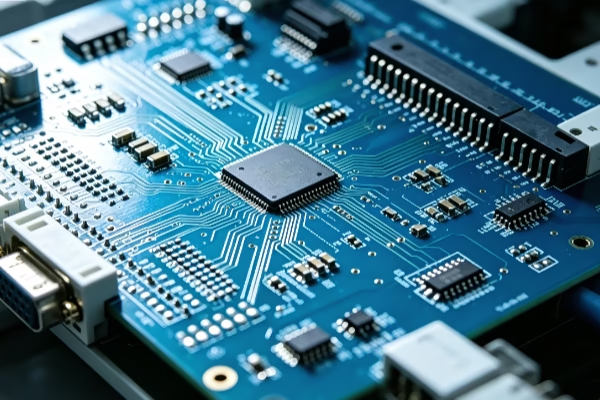
What is a Smart Medical PCB Solution?
A smart medical PCB solution refers to a complete support system that covers everything from PCB design to final product delivery, based on the functional requirements of medical electronic products.It is not just a board fabrication service. Instead, it integrates circuit design, material selection, structural optimization, manufacturing processes, assembly workflows, and testing validation into a closed-loop system.Medical devices demand extremely high precision and reliability, so PCB solutions must ensure signal stability, anti-interference capability, heat dissipation performance, and long-term durability.Smart medical PCB solutions are typically used in the following product categories:
Monitoring devices: Require continuous stable operation without signal drift or power interruption risk
Diagnostic devices: Require high-precision signal acquisition and low-noise circuit support
Wearable medical products: Emphasize thinness, miniaturization, and low power consumption
Therapeutic devices: Require higher safety, heat resistance, and structural strength
Core Value of Smart Medical PCB Solutions
| Core Value | Key Performance | Value to Customers |
| Stability | Reduced failure rate | Longer device lifespan, fewer after-sales issues |
| Safety | Improved electrical and structural safety | Better compliance with medical requirements |
| Consistency | Smaller batch variation | Smoother mass production |
| Delivery Efficiency | Shorter prototyping and introduction cycle | Faster time-to-market |
How is a Smart Medical PCB Solution Developed?
A mature medical PCB solution does not start at manufacturing. It begins at the early project stage.It typically follows a workflow of requirement analysis, design review, prototyping, validation, pilot production, mass production, and continuous optimization.The key is not “speed,” but “stable acceleration,” ensuring each step lays a solid foundation for later mass production.
Step 1: Requirement Definition
Define application purpose, signal types, size constraints, power consumption, operating environment, and certification goals.
Medical products are highly sensitive to noise, temperature rise, and safety boundaries, so requirements must be clearly defined from the beginning.
Step 2: Engineering Review
Review PCB layer stack-up, trace width, impedance control, component layout, thermal paths, and EMC performance to identify potential risks early.
Step 3: Prototype Fabrication
Validate circuit logic, structural space, and assembly feasibility using prototype boards, allowing early correction of design issues.
Step 4: Assembly and Testing
Perform SMT/DIP assembly, functional testing, aging tests, and reliability validation to ensure stable operation under real-world conditions.
Step 5: Mass Production Introduction
Optimize process parameters based on pilot runs, transition into mass production, and establish traceability and quality control systems.
Typical Implementation Process
| Stage | Key Task | Output |
| Requirement Definition | Define application scenario | Clear project objectives |
| Engineering Review | Identify design risks | More reliable solution |
| Prototype Build | Validate function and structure | Early problem detection |
| Testing Validation | Check stability | Improved product usability |
| Mass Production | Standardized manufacturing | Better batch consistency |
How to Improve Smart Medical PCB Solutions?
The key to a successful medical PCB solution lies in detail control.Medical devices are not consumer electronics—many issues do not appear immediately but are revealed during long-term operation. Therefore, signal integrity, thermal management, structural strength, EMI resistance, and manufacturability must be considered from the very beginning.Medical devices often include sensors, analog signal processing, and high-speed data transmission, requiring well-planned routing to reduce crosstalk and noise.In addition, many diagnostic and therapeutic devices generate continuous heat. If thermal paths are not properly designed, component degradation or reduced lifespan may occur.Medical environments are often dense and complex, so PCBs must minimize interference to avoid misjudgment or signal distortion.Design should not only focus on electrical correctness but also manufacturability, solderability, testability, and maintainability.
Technical Focus Areas
| Technical Item | Key Focus | Common Risks |
| Signal Integrity | Impedance, crosstalk, noise | Inaccurate data, signal distortion |
| Thermal Management | Copper distribution, component layout | Local overheating, reduced lifespan |
| EMC Control | Shielding, grounding, return paths | Strong interference, malfunction |
| Manufacturability | Pads, test points, panelization | Difficult assembly, rework, poor testability |
What Materials Are Suitable for Smart Medical PCBs?
Material selection directly affects reliability, lifespan, and manufacturability.Medical devices require higher material standards than general electronics because they must operate continuously, maintain stable output, and withstand cleaning, sterilization, and environmental changes.Material selection should not be based on cost alone, but on stability and compatibility.Common considerations include substrate, copper foil, surface finish, solder mask, and bonding materials.For high-stability main control boards, materials with strong dimensional stability and heat resistance are preferred. For wearables or compact devices, flexible or rigid-flex materials are better suited for lightweight and bending requirements. For high-density interconnect products, more precise lamination and material control are required.Surface finishes must also be selected based on solder reliability and long-term storage performance.Material selection is not isolated—it must align with functionality, assembly processes, and testing standards.
For example:
Humid environments require higher moisture resistance and insulation performance
Thermal cycling-sensitive devices require better thermal expansion matching
Frequent bending applications require strong fatigue resistance
Only when materials match the application scenario will reliability testing results be meaningful.
Common Material Categories
| Material Type | Application | Selection Principle |
| Rigid materials | Main boards, diagnostic devices | Stable, heat-resistant, mass-producible |
| Flexible materials | Wearables, compact devices | Lightweight, bendable, fatigue-resistant |
| Rigid-flex materials | Complex structural devices | Balance strength and space efficiency |
| Surface finishes | Soldering & protection | Good solderability, high reliability |
Why Choose a One-Stop PCB Solution?
Most customers are not only concerned with “whether it can be made,” but more importantly with “whether it can reduce problems, rework, and delays.”Smart medical product development cycles are tight. Any issue in any stage can affect prototyping, testing, certification, and mass production.A one-stop PCB solution integrates design, manufacturing, assembly, testing, and delivery, reducing communication costs and avoiding errors caused by fragmented information.For medical customers, a unified solution also means clearer responsibility boundaries, better traceability, and smoother project execution.
The importance of smart medical PCB solutions ultimately comes down to four words: stable, accurate, fast, and cost-efficient.
Stable: Medical devices must not easily fail
Accurate: Signals and functions must be reliable
Fast: Faster prototyping and product introduction
Cost-efficient: Better early design reduces rework and maintenance costs
In the medical industry, PCB is not just a processing component—it is the foundation of overall device performance. A well-designed PCB solution does more than ensure functionality; it ensures long-term stability, safety, and reliability.
Your Trusted One-Stop PCB Manufacturing and Assembly Partner
Founded in 2000 and headquartered in Shenzhen, China, Toplay Circuit is an electronic solution provider offering PCB layout, manufacturing, assembly, testing, and validation services. Its product range includes high-reliability flexible PCBs, rigid-flex boards, RF/microwave boards, HDI boards, and rigid PCBs.As a recognized technology leader, Toplay Circuit delivers fast turnaround times with all solutions completed in-house, providing a true one-stop service experience.We offer one-stop PCB manufacturing and assembly services covering prototyping, mass production, SMT/DIP assembly, testing, and delivery. From engineering review to shipment, we focus on quality control and delivery reliability. Clear communication helps customers transition from prototype to production more efficiently.